


The partnership aims to make everyday PC interactions more natural for Indian users by combining HP’s hardware with Sarvam AI’s multilingual voice technology, initially through Kivi, with plans to explore broader AI-powered computing experiences.
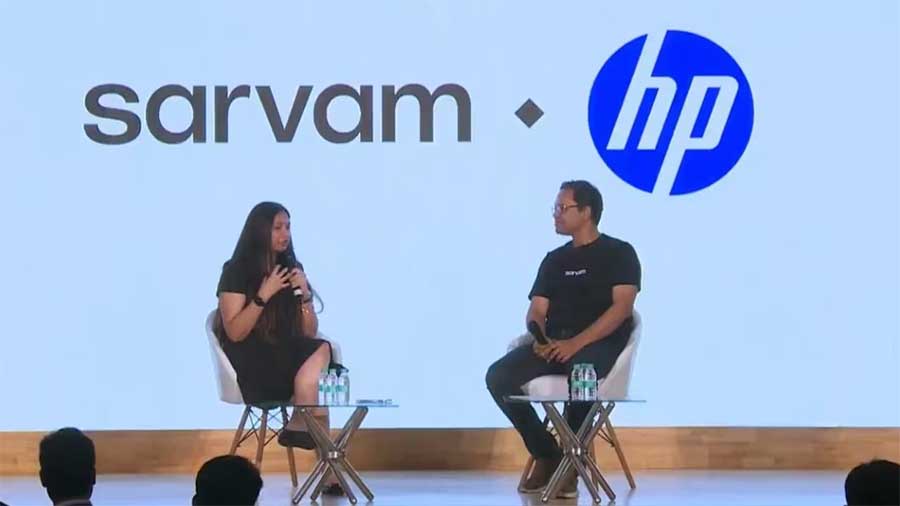
HP has partnered with Indian artificial intelligence company Sarvam AI to bring voice and language-based AI capabilities to its personal computing devices, with an initial focus on enabling users to interact with PCs through Indian languages.
The two companies have signed a memorandum of understanding (MoU) under which Sarvam’s voice AI technology will be integrated with HP devices at scale. While voice interaction is the first area of collaboration, the companies intend to explore additional AI-driven experiences that could change how users interact with their computers.
The partnership combines HP’s established PC ecosystem with Sarvam’s focus on developing AI technologies for Indian languages and use cases. Sarvam says its technology supports more than 22 Indian languages and can handle code-switching, allowing users to move between languages naturally during conversations.
Kivi brings voice-based productivity to PCs
A key application being highlighted through the partnership is Kivi, a voice-powered application developed using Sarvam’s AI capabilities. Rather than requiring users to type commands or navigate through multiple menus, Kivi is designed to let them communicate with the PC using spoken instructions.
The application can support tasks such as dictating text, creating or rewriting content, finding information and assisting users with ongoing work. It can also interact with applications already being used on the computer.
The companies are positioning this as more than an additional voice-assistant feature. Their broader objective is to establish voice as another way of controlling and working with a PC, particularly for users who may be more comfortable communicating verbally than navigating conventional keyboard-and-mouse interfaces.
This approach could have particular relevance in India, where users routinely communicate in multiple languages and frequently switch between languages during conversations. Many existing digital interfaces, however, continue to rely heavily on English-language commands, keyboards and search inputs.
Building a multilingual computing experience
Sarvam’s AI portfolio is designed around Indian-language requirements, with its broader platform supporting speech recognition across 12 Indic languages and translation across 23 languages. Integrating these capabilities into PCs could expand access to computing for users who are less comfortable operating technology primarily in English.
Potential use cases extend across education, content creation and workplace productivity. Students could dictate notes, professionals could create documents through voice, and multilingual users could communicate with applications without repeatedly changing language settings or adapting their input methods.
The companies also see the collaboration as part of a longer-term effort to develop more context-aware computing experiences. The MoU provides scope for HP and Sarvam to explore additional AI applications across devices and everyday workflows as expectations around personal computing evolve.
For Sarvam, the partnership represents another step in its strategy of deploying Indian-language AI beyond standalone models. The company operates across AI models, infrastructure and applications aimed at enterprises, government organisations and developers.
The collaboration also reflects a wider shift in the PC industry, where AI is increasingly moving from background processing into the user interface itself. For India, adding native multilingual voice capabilities could make that transition more relevant to the country's diverse user base.

See What’s Next in Tech With the Fast Forward Newsletter


Tweets From @varindiamag
Nothing to see here - yet
When they Tweet, their Tweets will show up here.


