


Breaking News

India’s fast-growing startup ecosystem could spawn “100 new Reliances” in the coming years, Mukesh Ambani said on Tuesday, signalling growing confidence in the country’s entrepreneurial depth and long-term growth prospects.
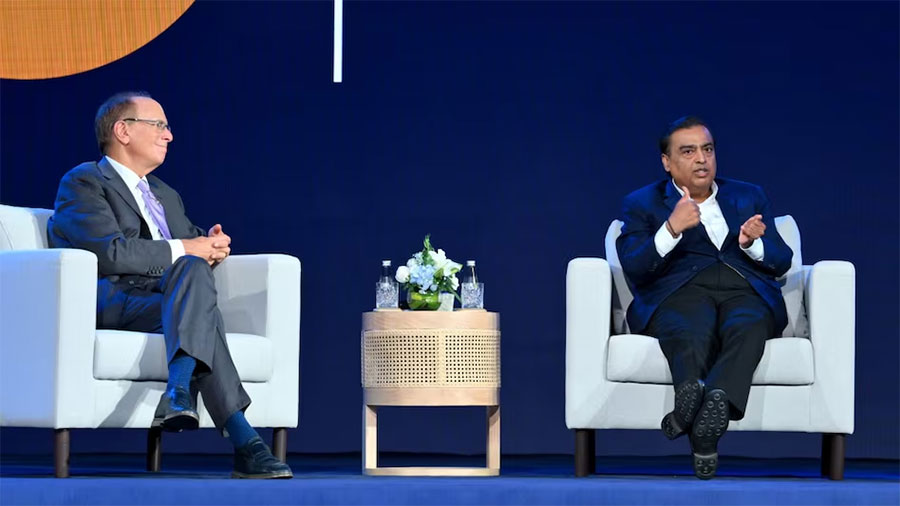
Speaking at a fireside chat with Larry Fink at JioBlackRock’s Investing for a New Era event in Mumbai, Ambani said interactions with young founders had convinced him that India was entering a phase where scale, ambition and execution capability were no longer limited to a handful of large conglomerates.
“When I interact with startups and see young 28-30 year olds starting companies, I can clearly see 100 new Reliances in terms of where they are going, the aspiration and the confidence they have,” Ambani said.
The comment underscores a shift in how India’s private sector is being viewed globally — not just as a market of consumption, but as a factory for large, globally competitive enterprises.
Speaking at a fireside chat with Larry Fink at JioBlackRock’s Investing for a New Era event in Mumbai, Ambani said interactions with young founders had convinced him that India was entering a phase where scale, ambition and execution capability were no longer limited to a handful of large conglomerates.
“When I interact with startups and see young 28-30 year olds starting companies, I can clearly see 100 new Reliances in terms of where they are going, the aspiration and the confidence they have,” Ambani said.
The comment underscores a shift in how India’s private sector is being viewed globally — not just as a market of consumption, but as a factory for large, globally competitive enterprises.
Confidence built on growth and stability
Ambani linked the surge in entrepreneurial ambition to sustained economic growth, policy continuity and infrastructure build-out over the past decade. India, he said, could sustain growth of 8–10% annually, with the possibility of double-digit expansion not ruled out.
Stable political leadership, predictable policy and relatively conservative fiscal management had laid the groundwork for this confidence, he added, pointing to India’s debt-to-GDP ratio of around 50%, well below that of many developed economies.
He also credited large-scale execution — from roads and ports to renewable energy and nationwide 5G rollout — for changing how young Indians perceive opportunity. “Parents today believe their tomorrow will be better than today. That is a big change,” Ambani said.
From savings to productive capital
The discussion took place against the backdrop of the launch of JioBlackRock, a joint venture between Reliance Industries and BlackRock, aimed at drawing more Indian household savings into capital markets.
Ambani argued that while Indians have traditionally been strong savers, a large portion of household wealth remains locked in unproductive assets. He cited India’s import of roughly $60 billion worth of gold in the past year as an example of savings not being deployed for economic growth.
“If we can convince the Indian saver to invest in capital markets in a safe, transparent and consistent way, those savings can compound — for individuals and for the economy,” he said.
That transition, Ambani suggested, would be critical if India is to fund the scale of opportunity ahead — from energy self-sufficiency and physical infrastructure to what he described as “country-scale intelligence infrastructure” built around AI.
India’s multi-decade opportunity
Both speakers framed India as a long-horizon investment story rather than a short-term macro trade. Ambani projected that India’s $4–4.5 trillion economy could grow to $25–30 trillion over the next 20–30 years, driven by technology adoption, infrastructure and productivity gains.
Fink echoed that view, urging Indians to “invest alongside the growth of their country” and arguing that broad participation in capital markets was essential for financial security and domestic capital formation.
For Ambani, the rise of startups capable of becoming large enterprises is central to that vision. “Even 100 Reliances may not be enough,” he said, pointing to the scale of value creation India could see over the next three decades.
If that prediction holds, India’s next phase of growth may be defined not by a single dominant conglomerate, but by dozens — or hundreds — of companies built by a generation that expects to operate at global scale.

See What’s Next in Tech With the Fast Forward Newsletter


Tweets From @varindiamag
Nothing to see here - yet
When they Tweet, their Tweets will show up here.


