
Akamai has introduced two foundational products for its AI stack: Akamai Inference and Akamai Agent Sandbox. With these additions, enterprises can build and tune their own or hosted open-weight models, ground them in their own data, run agents inside enforced boundaries, and secure the applications, agents, and infrastructure involved, all on one cloud platform with AI-optimized infrastructure.
These capabilities mark the latest step in Akamai's AI strategy: giving enterprises the trusted global infrastructure and services required to serve, run, and secure AI applications and agents, close to the users and data they depend on. Akamai Inference and Akamai Agent Sandbox now add managed services on top of that infrastructure — a foundation that has already secured multiyear contracts for Akamai Cloud collectively worth more than $14 billion. The momentum highlights how Akamai’s ability to leverage both CPUs and GPUs — together with cloud storage, networking, and edge functions on its interconnected global network fabric — is quickly becoming the trusted foundation for customers to build, deploy, and operate AI workloads at scale.
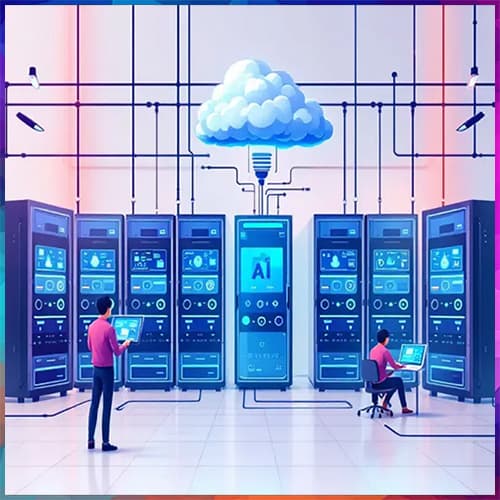
Enterprises moving AI into production need far more than models. They need serving infrastructure, access to their data, routing and governance, and, as agents begin to write and execute their own code, a hard boundary around what that code can reach. Most teams assemble those pieces from separate providers and secure the interaction points themselves. Akamai Cloud now delivers a connected AI environment, placed across a continuum of compute that runs from dense GPU and CPU clusters in core regions to more than 4,350 edge locations, and protected by the same security portfolio that defends many of the world’s largest online businesses.
"We have been implementing an AI infrastructure strategy based on the notion that AI inference will represent the majority of enterprise focus and investment. Our customers proved that thesis and pulled us further," said Adam Karon, Chief Operating Officer and GM of Akamai Cloud. "They want to build, run, and protect AI on the same platform. Akamai Inference and Akamai Agent Sandbox add the inference and execution layers that turn our AI infrastructure into a full AI stack, and our security portfolio protects every layer of it. Akamai is uniquely positioned to bring our scale and distribution to address scaling real-time inference and agentic workloads."
Access models without operating the stack: Akamai Inference
Akamai Inference gives enterprises managed access to open-weight and custom models through OpenAI-compatible APIs, so existing applications move without rewrites. Customers choose serverless, pay-per-use inference or dedicated deployments. At launch, the catalog includes 12 open-weight models ranging from 8 billion to 2.8 trillion parameters, including NVIDIA™ Nemotron 3 Ultra, OpenAI™ gpt-oss-120b, and Google™ Gemma 4, along with embedding models for retrieval-augmented generation.
Akamai Cloud provides access to managed databases and object storage, and seamlessly connects to private and public cloud platforms, so models can draw on enterprise data. Akamai Inference then handles the orchestration, model execution, and authentication. Requests run on the Akamai global network, which reduces latency, and helps to ensure high availability and consistent performance while maintaining predictable service levels.
Give agents a place to execute: Akamai Agent Sandbox
AI agents are increasingly doing real work, from taking actions on a user’s behalf to writing and running their own code. Akamai Agent Sandbox gives developers a secure place to run both. Agents run on Akamai Functions, and the code they write runs in its own isolated environment, sequestered from the agent’s runtime. Delivered as an open source component of the Spin framework, Akamai Agent Sandbox uses WebAssembly isolation to set clear limits on compute, memory outbound connections, and system capabilities. Developers can deploy agents with confidence about where they run and what they can reach.
Agent isolation is converging on several models, from microVMs with snapshot and fork capability, to policy-enforced containers, to WebAssembly-isolated functions. Akamai allows developers to choose the architecture that fits their workload, with NVIDIA-accelerated and dedicated CPU infrastructure, managed Kubernetes, and Akamai Functions for serverless execution across edge and core. Akamai also plans to add capabilities that govern what agents can reach and what can reach them.
"Enterprises should not have to choose between speed and control when they put AI into production," said Jon Alexander, Senior Vice President of Cloud Technology at Akamai. "Some teams want to ship an AI feature this quarter on a managed platform. Others need dedicated GPUs to run frontier-class open models on their own terms. Every team running agents needs a boundary around the code those agents write. Akamai Cloud now supports all of them on one platform, with security and resilience built in."