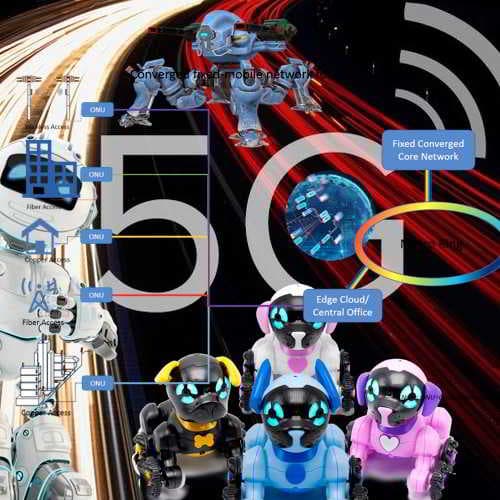
While previous generations - 1G, 2G, 3G to 4G wireless networks enabled human to human and human to machine interaction, 5G will see machines communicating with machines
The next generation of doctors have some exciting times ahead. Imagine a robot waiting for operation. Ultra high cameras are embedded in OT. Doctor is sitting thousand kilometer ahead, giving instructions to the robot and the operation process is becoming a success. At the same time a farmer is at his home and through a drone keeping an eye on the crop and their health. The autonomous robot look out for any crop diseases, informing the farmer about the soil status, humidity and brief details about the crop disease. The Drone then takes action for fertilizers or pesticides.
This age is coming with the latest 5G infrastructure
This is just a glimpse of the future of communication, where human intervention will be bare minimum. The key element here is 5G, the next generation of mobile internet connectivity.
“5G is the base to make a connected world come true. Collaboration will be an important part of this: working with the government, academia and industry. We need to create an ecosystem to make 5G happen in India,” said Claudia Park, director, networks, Samsung Electronics Co. Ltd, at a recent briefing on 5G technology at the Samsung Digital City in Suwon, South Korea. “Agriculture is one of the more important use cases applicable to India. We are in discussion with the department of telecommunications (DoT) about conducting 5G trials in India in the first quarter of next year,” she adds.
But what makes 5G unique? For one, the implementation of 5G will reduce the latency or lag in data transmission. The response time in 4G is around 50 milliseconds. With 5G, latency is expected to come down to 1 millisecond. Users will be able to download video files as big as 500-600 megabytes in just five to six seconds.
In bigger scenarios like smart cities, 5G could be the key to, say, better monitoring of traffic. Samsung Electronics has established a ‘5G City’ within the Digital City to demonstrate this. CCTV cameras, digital signages, and IoT (internet of things) sensors are connected through 5G, Wi-Fi and Bluetooth, etc. This expands the network capacity and allows a more accurate way of monitoring traffic. On the streets, CCTV cameras and video software detect the speed of cars and monitor for pedestrians' jaywalking. In an emergency, a notification pops up on the screens at a central command centre.
Samsung also showcased how 5G networks will transform everything from our homes and streets at the India Mobile Congress in New Delhi last month. The company also announced its plan for India’s first large-scale 5G trial, slated for the first quarter of 2019 in collaboration with the DoT.
The use of 5G as a commercial solution is gathering momentum globally. Samsung already provides 4G and 5G solutions to telecom operators in the US and South Korea. And, according to the Ericsson Mobility Report June 2018, one billion 5G devices for enhanced mobile broadband are expected to be connected worldwide by 2023.
“The need for human intervention will really depend on the services and use cases. For example, if we are looking at the use of 5G in healthcare, then the need for human intervention will be a lot. A doctor should be there. But in the case of IoT, human intervention will be minimized,” Park adds.
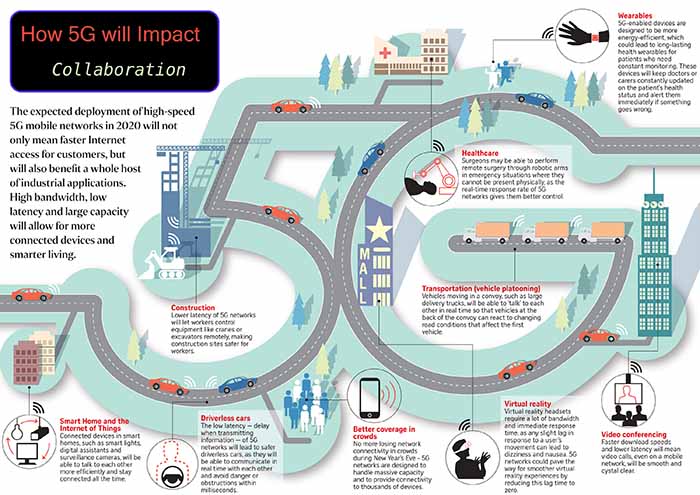
5G is rapidly developing and it is becoming the technology that everyone is moving towards. Not only will it be able to accommodate the superfast speeds required of it, but it will also be possible to accommodate the low data rate requiremets for IoT and IIoT applications. As such 5G will be able to encompass a huge number of different applications, and accommodate many differnet data types.