
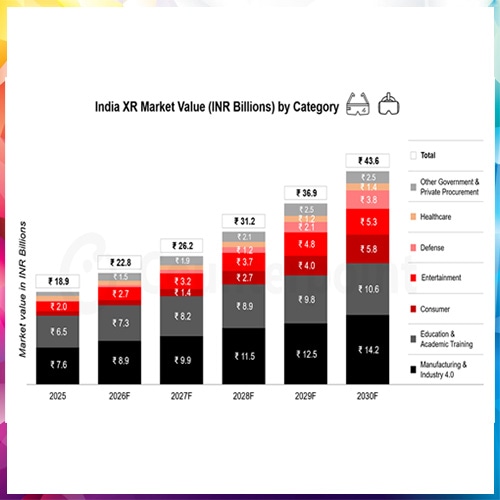
India's extended reality (XR) market is poised for significant expansion, with its value projected to reach ₹43.6 billion by 2030, up from ₹18.9 billion in 2025, according to Counterpoint Research. The market is expected to register an 18% compound annual growth rate (CAGR), fueled by rising enterprise adoption, immersive training, and growing demand for industry-specific applications.
Enterprise applications remain the backbone of India's XR ecosystem, accounting for 95% of market value in 2025. Although their share is expected to decline to approximately 87% by 2030 as consumer adoption grows, businesses will continue to drive the industry's expansion.
Manufacturing and education are leading this transformation, together contributing nearly 78% of enterprise XR spending in 2025. Manufacturing XR investments are projected to increase from ₹7.6 billion to ₹14.2 billion by 2030, while education spending is expected to rise from ₹6.5 billion to ₹10.6 billion.
The shift highlights XR's evolution beyond entertainment into practical applications such as industrial simulation, workforce training, virtual laboratories, equipment maintenance, and immersive learning. Software, content development, and systems integration are becoming increasingly important revenue drivers.
India's XR Hardware Market Gains Momentum
XR headset shipments are forecast to grow at a 27% CAGR through 2030, while wholesale hardware market value is expected to expand from approximately ₹2 billion to ₹9 billion.
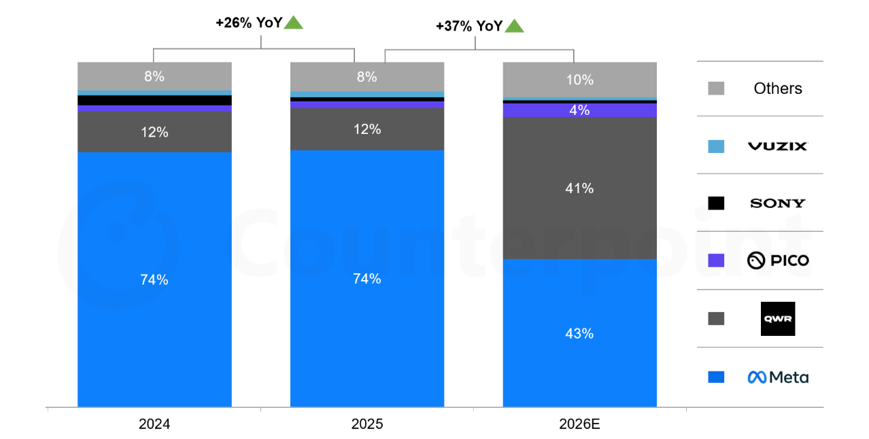
Meta dominated India's XR headset market in 2025 with a 74.4% shipment share. However, domestic manufacturer QWR is rapidly emerging as a strong competitor, with its share projected to reach 41% in 2026, compared with Meta's estimated 43%.
QWR's growth reflects increasing demand for locally designed, enterprise-focused XR devices, particularly across education and industrial applications. Its emphasis on customized solutions and domestic support demonstrates the competitive potential of Indian technology manufacturers.
Meanwhile, display-enabled augmented reality glasses could account for nearly 42% of XR headset shipments by 2030, supported by lighter designs and expanding use cases.
Consumer XR Market Poised for Sevenfold Growth
India's consumer XR market is projected to expand from ₹850 million in 2025 to ₹5.8 billion by 2030. Gaming, immersive entertainment, and affordable AR glasses are expected to stimulate adoption.
However, high device prices, limited localized content, and inadequate distribution networks remain significant barriers.
India's Opportunity: From XR Adoption to Global Innovation
Counterpoint Research identifies India's strengths in software engineering, immersive content, artificial intelligence, and systems integration as major competitive advantages.
Nevertheless, dependence on imported processors, displays, memory, and advanced optical components continues to constrain domestic hardware manufacturing.
Building a stronger component ecosystem, expanding engineering capabilities, and developing scalable enterprise solutions will be essential for India to move beyond device assembly.
The larger opportunity lies in positioning India as a global hub for enterprise XR innovation. As immersive technologies converge with AI, digital twins, and industrial automation, companies that combine indigenous hardware, specialized software, and industry expertise will be best positioned to capture the next wave of digital transformation.