
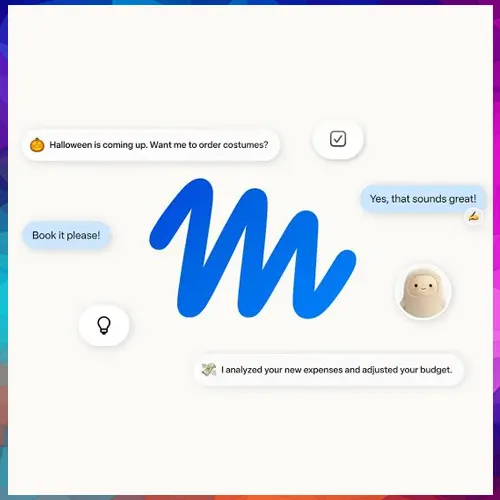
Meta’s new autonomous AI assistant is designed to execute tasks across email, travel and online services, marking a shift from conversational AI towards agents that can independently carry out multi-step activities for users.
Meta has introduced a new autonomous AI assistant called Muse, positioning the technology as a step towards AI systems capable of completing tasks rather than simply responding to user prompts. The assistant can handle activities such as sending emails, listing a vehicle for sale and making travel arrangements, according to the company.
Meta CEO Mark Zuckerberg described Muse as a personal agent designed to understand users’ objectives and work continuously to complete them. The service is initially being rolled out to users in the US and is available through a dedicated application as well as WhatsApp. Meta said the assistant is being offered across iOS, Android and the web, with free and paid access options, while integration with its AI-enabled smart glasses is expected in the future.
The launch represents a broader push by Meta into agentic AI, where software is designed to perform actions on behalf of users. The company is positioning the technology as part of Zuckerberg’s longer-term vision of delivering what he has referred to as “personal superintelligence” across Meta’s platforms.
Muse connects AI with personal services
Muse is built using the open-source OpenClaw framework and can connect with services such as calendars, email accounts, financial platforms, smart-home devices and health applications. Users have to authorise individual services before the assistant can access them and can withdraw those permissions later.
Rather than functioning solely as a conventional chatbot, each Muse session operates inside an isolated cloud-based virtual machine configured to resemble a personal computer. This setup allows the agent to perform tasks over longer periods in the background without requiring users to remain actively engaged with it.
The approach, however, also raises questions about the risks associated with giving an AI system access to highly sensitive personal information. The ability to execute transactions and interact with multiple services introduces potential concerns around incorrect actions, privacy breaches and unintended use of data.
Meta has sought to address those concerns by adding security controls to the architecture. Vishal Shah, the company’s vice president of AI products, said the engineering changes brought Muse within Meta’s baseline requirements for privacy, security and model performance.
"It is impossible to say that there is never going to be a mistake, but every single part of the architecture has been designed to make this as safe, as secure, as private as we can possibly make it," Shah said.
Meta AI chief Alexandr Wang said the application operates within an isolated environment in Meta’s infrastructure and does not have access to users’ actual passwords or payment details.
Meta pushes further into agentic AI
Muse arrives as technology companies increasingly compete to develop AI agents capable of carrying out real-world tasks. The distinction from traditional assistants is that agentic systems can potentially plan and execute a sequence of actions instead of requiring users to direct every individual step.
Meta has been expanding its AI portfolio across its consumer platforms. In July, the company introduced Meta AI Image, an image-generation feature that allowed users to create images using their Instagram photographs. The move also generated attention around how users with public Instagram accounts were automatically included in the feature unless they opted out.
The Muse launch also comes as Apple prepares to advance its own AI ambitions around Siri. Apple is expected to showcase new AI capabilities for its voice assistant alongside its latest iPhone lineup, increasing competition among major technology companies seeking to turn AI assistants into more capable digital agents.
For Meta, Muse represents a move towards AI that can act independently on a user’s behalf. The challenge will be balancing that convenience with safeguards strong enough to prevent autonomous systems from making costly mistakes or mishandling sensitive information.