During visits to SpaceX and OpenAI, Jensen Huang showcased the DGX Spark, a shoebox-sized AI supercomputer designed to bring data center performance to desks and labs worldwide
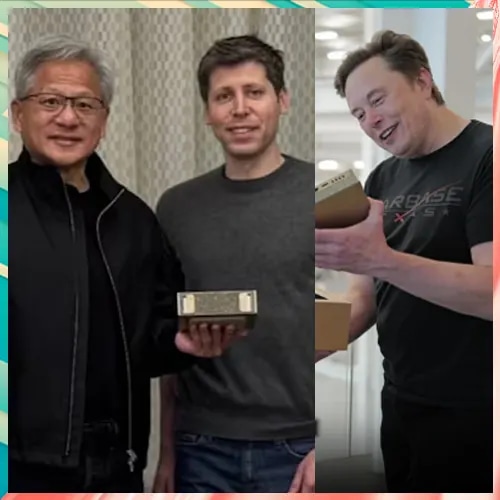
In a rare and symbolic gesture, Nvidia CEO Jensen Huang personally delivered the company’s latest AI supercomputer, the DGX Spark, to two of Silicon Valley’s most influential tech leaders — Elon Musk and Sam Altman — marking a new era in portable, high-performance AI computing.
The deliveries were made during a whirlwind tour that first took Huang to SpaceX’s Starbase in Texas, where he met with Musk ahead of the company’s Starship test flight. Shortly after, he flew to San Francisco to present the same system to OpenAI CEO Sam Altman at their headquarters — a nod to Nvidia’s long-standing relationship with both organizations.
A shoebox-sized supercomputer with petaflop power
Despite its compact form — roughly the size of a shoebox — the DGX Spark packs up to 1 petaflop of AI performance, thanks to Nvidia’s Grace Blackwell GB10 Superchip. It’s a major leap from the earlier DGX-1 system Nvidia delivered to OpenAI in 2016, which helped fuel the organization’s early breakthroughs in artificial intelligence.
Huang described the Spark as a “personal AI supercomputer,” offering the power of a data center in a desktop-sized package. With 128GB of unified memory, advanced networking capabilities, NVMe storage, and direct HDMI output, the device is engineered to handle heavy-duty AI workloads such as model training, inference, and generative applications — all without relying on the cloud.
Wider launch and industry adoption
The DGX Spark officially went on sale globally on October 15 via Nvidia’s website and select hardware partners, including Dell, HP, Lenovo, ASUS, and others. Early adopters include universities, AI labs, and creative studios, reflecting the device’s versatility across sectors.
The dual delivery wasn’t just marketing flair — it was a powerful statement about the future of AI. By placing one of the world’s most powerful portable AI systems next to the world’s largest rocket, and later in the hands of the leading AI lab, Huang underscored Nvidia’s mission: making advanced AI computing accessible, mobile, and personal.