
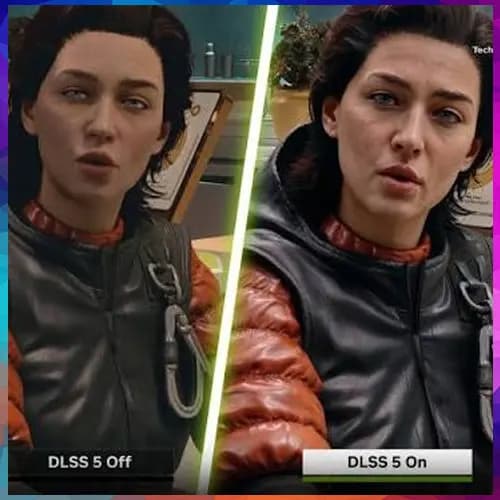
Nvidia’s newest graphics technology brings AI deeper into game rendering, aiming to deliver richer lighting, materials, reflections and environmental detail while giving developers greater control over the final visual experience.
Nvidia has unveiled DLSS 5, the latest generation of its Deep Learning Super Sampling technology, marking a significant shift in how artificial intelligence is used to create real-time game graphics. The new system introduces 3D-Guided Neural Rendering, which applies AI within the rendering pipeline to improve visual elements such as lighting, materials and environmental detail.
Unlike earlier DLSS versions that concentrated primarily on upscaling, frame generation and ray reconstruction, DLSS 5 works with information produced by the game engine to enhance the rendered image itself. Nvidia says the approach is intended to bring real-time graphics closer to the level of visual quality associated with film production, while retaining the creative direction established by game developers.
AI moves deeper into the rendering pipeline
DLSS 5 is scheduled to debut in NBA 2K27 on September 3 at 9 PM PT. Support will extend across GeForce RTX 50 Series desktop graphics cards, RTX 50 Series laptops and GeForce NOW Ultimate, giving both PC and cloud gamers access to the technology.
The neural rendering system draws on existing engine data, including colour information, motion vectors, surface normals, albedo, lighting buffers and geometry. Nvidia says these inputs allow the AI model to refine elements such as skin, hair, foliage, reflections, shadows and global illumination without relying on text prompts.
The company also says the system follows a one-frame-in, one-frame-out process. This is designed to reduce temporal inconsistencies and maintain stable visuals during rapid camera movement. Because the AI is guided by the original rendered frame and game-engine information, Nvidia says the results remain deterministic rather than introducing unpredictable visual changes.
Developers can also decide where and how strongly neural enhancements are applied. DLSS 5 offers adjustable controls, including Structure Intensity and Tone Intensity, while semantic AI masking can target specific elements such as faces, foliage, water, glass and other objects. Engine-level masking provides another layer of control, allowing artists to tailor effects to individual assets.
NBA 2K27 leads the DLSS 5 rollout
Visual Concepts collaborated with Nvidia to integrate DLSS 5 into NBA 2K27. The technology is designed to improve facial lighting, skin shading, contact shadows, hair and material rendering while preserving the appearance of real-world players. Nvidia highlighted players including Cade Cunningham, Tyrese Haliburton and Jayson Tatum to demonstrate improvements in skin tones, facial detail and lighting.
DLSS 5 is integrated through Nvidia’s Streamline framework and an Unreal Engine 5 plugin, potentially simplifying adoption for studios already using Nvidia’s DLSS technologies.
Nvidia is also positioning the technology as a performance-friendly graphics upgrade. The company claims an RTX 5090 can deliver up to 370fps at 4K with ray tracing and the full DLSS 5 suite enabled. At 1440p, Nvidia cites figures of up to 590fps on the RTX 5090, 410fps on the RTX 5080, 350fps on the RTX 5070 Ti and 260fps on the RTX 5070.
Players will require Nvidia’s new GeForce Game Ready Driver, launching alongside NBA 2K27. DLSS Neural Rendering can be enabled from the game’s video settings alongside Super Resolution, Multi Frame Generation, Ray Reconstruction and Nvidia Reflex. Nvidia says additional AI model and performance improvements are planned for later this year.