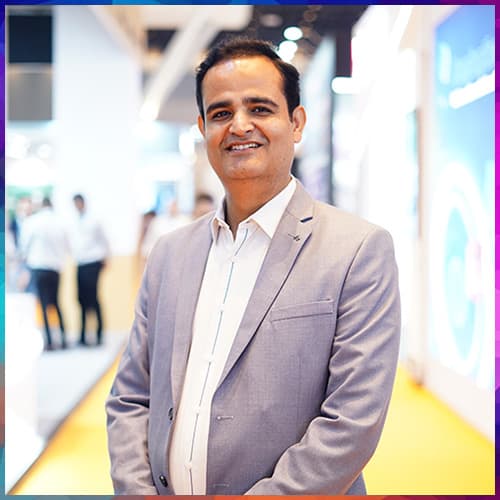

VINCENT CALDEIRA
CTO, RED HAT APAC
Over the next three to five years, Red Hat's growth strategy will center on advancing multi-vendor open standards that foster interoperability, reduce vendor lock-in, and enable customers to innovate with greater flexibility while also fostering industrialization of the open-source AI ecosystem. By championing an open, collaborative AI ecosystem, Red Hat aims to empower enterprises to scale AI with confidence while avoiding dependence on proprietary, monolithic platforms.
Vincent Caldeira, CTO, Red Hat APAC details how Red Hat aligns the brand’s long-term vision and purpose with emerging technologies like AI, Edge AI and Agentic AI -
AI is increasingly becoming infrastructure-level technology for enterprises. The real shift underway is that organisations are moving beyond isolated experimentation and beginning to consider how AI can be embedded in core business systems, operational workflows and decision-making environments.
“What organizations increasingly want today is structural freedom without compromising enterprise control. At Red Hat, our vision centers on delivering a consistent, common software stack that spans the entire hybrid cloud—from core data centers to sovereign environments and resource-constrained edge points,” says Vincent Caldeira, CTO, Red Hat APAC. “By abstracting underlying hardware heterogeneity, we allow organizations to optimize and deploy intelligent applications and workloads across diverse silicon architectures, including NVIDIA, AMD, and Intel, without rewriting a single line of application code or succumbing to fragmented technology silos.”
AGENTIC AI MARKING AN IMPORTANT SHIFT
Agentic AI marks an important shift in how enterprises will interact with AI systems. We are moving beyond AI that simply responds to prompts toward systems that can independently reason, plan, and execute tasks with minimal supervision. That has the potential to significantly improve operational efficiency and accelerate enterprise decision-making.
The real question is where organizations still want humans in the loop, especially in high-impact or irreversible decisions. As autonomous agents evolve from basic chat completion into active digital entities that call APIs and interact with core systems, unchecked execution is an extreme enterprise liability. Red Hat's AgentOps strategy answers this shift via an unyielding principle: Bring Your Own Agent (BYOA).
“We do not compete at the framework layer: whether our customers build on LangChain, CrewAI, OpenClaw, or custom runtimes, we provide the enterprise infrastructure to make those agents production-ready. We also focus on addressing critical production gaps by wrapping agents in platform infrastructure: injecting cryptographically verifiable SPIFFE/SPIRE workload identities, enforcing granular tool-calling validation via an Envoy-based Model Context Protocol (MCP) Gateway, and executing tasks inside isolated boundaries using kernel-enforced OpenShell sandboxing. The driving idea here is to take agent security out of the hands of developers as much as possible, and enforce it natively at the platform level,” says Vincent.
LEVERAGING EDGE AI
Edge AI becomes especially important in environments where latency, responsiveness, operational continuity, and real-time intelligence directly affect business outcomes. Deploying AI at the far edge requires highly optimized pipelines that can function inside constrained hardware architectures.
Red Hat achieves this by providing a unified core-to-edge execution plane. Organizations can train or tune large open-weight models centrally using Red Hat OpenShift AI and then seamlessly push optimized, compressed versions (via low- precision technologies like INT4/FP4 quantization) to remote locations.
“In addition, through Red Hat Device Edge and MicroShift, we embed Kubernetes-based AI inference directly into resource-constrained endpoints such as industrial sensors and IoT gateways. By serving models locally behind containerized microservices through our Inference engine based on vLLM, we eliminate public internet dependencies and data exfiltration risks while delivering sub-second response times without cloud egress costs.
As AI adoption matures, we also expect that simplifying operations across distributed environments while maintaining visibility, scalability, and governance will become increasingly more important,” explains Vincent.
BUILDING CREDIBILITY & LEADERSHIP
Trust cannot be built within a closed 'black-box' ecosystem; it requires a transparent, reproducible, and fully verifiable software supply chain.
“For this reason, we are driving the industry to deliver this 'glass-box' transparency by packaging models as secure OCI artifacts, integrating continuous container vulnerability scanning through our trusted software supply chain solutions, which now unifies traditional software development and AI supply chain,” says Vincent.
He further continues, “Our safety portfolio moves governance from static policy to runtime enforcement: our TrustyAI operator manages real-time input/output conversational rails, while our proactive red-teaming framework utilizes Garak vulnerability scanning integrated with acquired algorithmic techniques from Chatterbox Labs. We treat data sovereignty as a foundational default, enabling organizations to enforce declarative regional boundaries via a Policy-as-Code framework so sensitive enterprise data never has to move.”
Red Hat strongly believes that organizations that can balance innovation with strong governance and long-term operational discipline will ultimately be better positioned to build credibility and sustained customer confidence.