

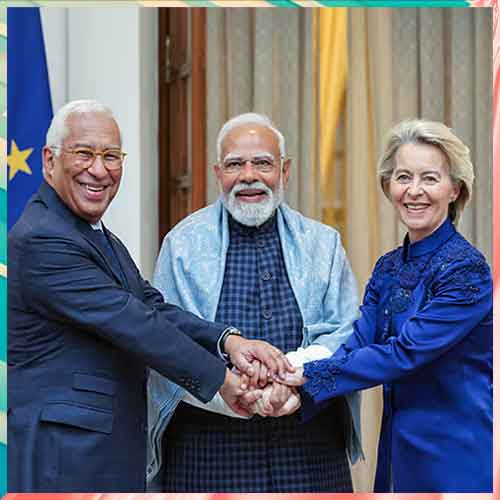
The signing of the India–EU Free Trade Agreement marks a significant geopolitical and economic milestone, underscoring the decisive leadership and strategic clarity of Prime Minister Shri Narendra Modi alongside the European Union’s political leadership. At a time when the global economic order is being reshaped by fragmentation, supply-chain realignments, and technology-led competition, the agreement sends a strong signal of mutual trust, stability, and long-term strategic intent between India and Europe.
Beyond trade liberalisation, the FTA reflects a deeper convergence of priorities—particularly in digital infrastructure, secure connectivity, space collaboration, and next-generation networks. These sectors are increasingly central to economic resilience and strategic autonomy. The agreement creates a structured framework for European investors to partner with India’s fast-growing digital economy, leveraging India not only as a large domestic market but also as a base for innovation and global scale.
Equally important, the FTA is not a one-way investment corridor. It opens meaningful opportunities for Indian enterprises to expand their footprint in Europe. Indian companies, including major digital infrastructure and telecom players such as Airtel, are well positioned to invest in Europe’s evolving connectivity, cloud, and digital services landscape, contributing capital, operational expertise, and technology at scale.
From a broader perspective, the India–EU FTA reinforces the shift toward trusted economic partnerships built on shared values, regulatory alignment, and long-term collaboration rather than transactional trade. It strengthens the foundation for co-creation across critical technologies while enhancing economic resilience on both sides.
This agreement represents a turning point in the India–EU relationship—one that aligns economic growth with strategic cooperation. It is a collective achievement for the leadership and citizens of India and the European Union, and a forward-looking step toward a more integrated and future-ready partnership.
Sunil Bharti Mittal, Founder and Chairman, Bharti Enterprises
“The signing of the India-EU FTA reflects the decisive leadership & strategic resolve of Prime Minister Shri Narendra Modi and the European political leadership in strengthening the India–EU partnership.
In a changing global economic order, the agreement sends a powerful signal of trust, stability, and long-term partnership.
I am confident that this FTA will open new avenues for collaboration, particularly in digital infrastructure, space connectivity, and secure networks, offering European investors a compelling opportunity to innovate and scale with India for global markets.
This agreement also opens opportunities for Indian companies like Airtel to invest in the digital infrastructure in Europe.
I congratulate our leadership and the people of India and the European Union on this turning point in our shared future.”
NASSCOM
“Nasscom applauds the conclusion of the India-EU FTA today. While goods see major tariff cuts, services gains are more about opening markets and rules-based predictability.
Services being dominant and fastest growing part of both economies, the gains would be in the form of better EU market access for Indian tech. This could lower non- tariff barriers and ease cross border delivery. Digital trade rules to support business while protecting privacy, security and public policy. Indian IT firms stand to gain from greater opportunities in Europe, including easier cross-border provision of services (Mode 1 under GATS) and potentially improved mobility for professionals (though Mode 4)
India and EU have agreed on constructive framework to enable Social Security Agreements in 5 years with all the EU Member States.
The agreement fosters deeper EU-India ties in technology, innovation, and digital areas (building on the India-EU Trade and Technology Council). This could lead to more EU investment in India's IT ecosystem, joint ventures, RCD in AI, semiconductors, clean tech, and startups. Indian IT companies could benefit from technology transfer, co- creation, and expanded partnerships.
By boosting bilateral trade and economic ties, the deal supports job creation, MSME growth in tech, and overall confidence for investors in India's services sector. The FTA includes dedicated SME chapters with contact points and digital platforms.
Given the geopolitical challenges, the FTA diversifies markets for Indian IT exporters, providing a hedge against global trade uncertainties. It strengthens India's position in global value chains for digital services.”

See What’s Next in Tech With the Fast Forward Newsletter





Tweets From @varindiamag
Nothing to see here - yet
When they Tweet, their Tweets will show up here.