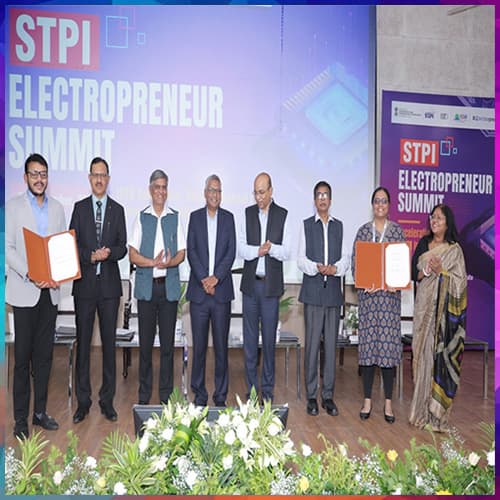
Software Technology Parks of India (STPI), under the Ministry of Electronics and Information Technology (MeitY), organized the Electropreneur Summit 2026 at IIIT-Delhi, bringing together government, academia, industry and investors to strengthen India’s Electronics System Design and Manufacturing (ESDM) ecosystem. The summit highlighted the growing importance of electronics, semiconductors, deep tech and product innovation in India’s technology ambitions.
A major announcement was the launch of the Open Challenge Programme of STPI Electropreneur Park, aimed at identifying and supporting promising ESDM startups and technology solutions. MoUs were also exchanged between AIC STPINEXT INITIATIVES, partner institutions and investors, including Indian Angel Network Services and Solara VC, expanding access to incubation, investment and mentoring.
The Electropreneur Park network is being extended through Spoke Centres across northern India, covering institutions in Chandigarh, Delhi, Haryana, Himachal Pradesh, Jammu & Kashmir, Rajasthan, Uttar Pradesh and Uttarakhand. The objective is to democratize access to ESDM incubation and bring entrepreneurial opportunities closer to innovators, including those outside major technology hubs.

Addressing the summit, K.K. Singh, Joint Secretary, MeitY, said India is entering a crucial phase where its global software leadership is being combined with an aggressive push into electronics manufacturing and semiconductors. Electropreneur Park 1.0 supported 59 startups, 66 patent filings and more than ₹640 crore in startup valuation. EP 2.0 now targets 500 startups, with greater participation from Tier-II and Tier-III cities.
Arvind Kumar, Director General, STPI, highlighted India’s dramatic electronics growth. National electronics production has expanded from below ₹2 lakh crore to over ₹13 lakh crore, while exports have increased to ₹4.24 lakh crore. EP 1.0 has also delivered 129 products, 27 trademarks, 66 patent filings and ₹150 crore in cumulative revenue.
Kumar said initiatives including GPU access through the IndiaAI Mission and ₹1.275 lakh crore under ISM 2.0 are creating new opportunities for entrepreneurs to build hardware, develop intellectual property and manufacture globally competitive products.
The summit also featured technical discussions on strengthening government-academia-industry collaboration for ESDM innovation. The larger message was clear: India’s next technology chapter must extend beyond software services. Turning engineering talent into patents, products, semiconductor capabilities and globally competitive electronics companies will determine whether India moves from being a technology services powerhouse to a global product and manufacturing innovation hub.