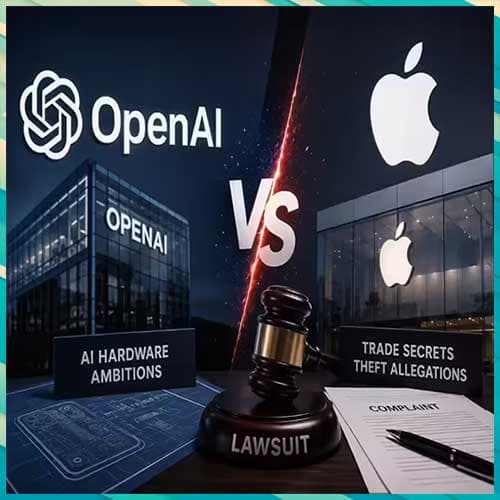
Apple has sued OpenAI and two former Apple employees, accusing the ChatGPT maker of misappropriating confidential hardware trade secrets to accelerate its push into consumer AI devices, escalating tensions between the two companies as they compete for the next generation of AI-powered hardware.
The lawsuit, filed in the U.S. District Court for the Northern District of California, alleges that OpenAI orchestrated a coordinated effort to obtain Apple's proprietary information through former employees, recruiting practices and supplier relationships to support its expanding hardware business.
Apple named OpenAI Foundation, OpenAI Group PBC, io Products—which OpenAI acquired—and former Apple executives Chang Liu and Tang Yew Tan as defendants.
According to the complaint, former senior system electrical engineer Chang Liu failed to return a company-issued laptop and later exploited an authentication flaw to access Apple's internal network, downloading confidential hardware-related files after leaving the company.
Apple also alleges that Tang Yew Tan, its former vice president of product design for the iPhone and Apple Watch, emailed himself confidential supplier information and internal industry analyses before joining OpenAI. Tan, who spent 24 years at Apple, is now OpenAI's hardware chief.
The complaint further alleges that Tan encouraged Apple employees interviewing with OpenAI to bring Apple hardware components to meetings for "show and tell" sessions. Apple cited one candidate as allegedly saying, "I didn't even know we could take those from the office."
OpenAI denied the allegations.
"We have no interest in other companies' trade secrets," the company said in a statement. "We remain focused on building innovative technology that empowers people everywhere."
The lawsuit marks a sharp deterioration in the relationship between Apple and OpenAI, which have collaborated on AI features while increasingly competing for talent and technology as generative AI becomes central to consumer computing.
The dispute also highlights growing competition over AI-native hardware, an emerging category that many in the industry believe could eventually reduce consumers' reliance on smartphones and traditional app ecosystems. Analysts have speculated that OpenAI is developing a phone or another consumer device designed around AI interactions.
"Apple sees OpenAI moving from partner to potential rival, while OpenAI is trying to reduce its dependence on the iPhone and build a direct relationship with consumers," Paolo Pescatore, an analyst at PP Foresight, told Reuters.
"Even if the allegations are not proven, the lawsuit could delay OpenAI's hardware ambitions and further weaken what is already becoming an increasingly fragile partnership," he said.
The case comes shortly after OpenAI prevailed in a separate legal challenge brought by Elon Musk's xAI, adding another high-profile dispute as competition intensifies among AI companies seeking to define the next generation of consumer devices.
The lawsuit, filed in the U.S. District Court for the Northern District of California, alleges that OpenAI orchestrated a coordinated effort to obtain Apple's proprietary information through former employees, recruiting practices and supplier relationships to support its expanding hardware business.
Apple named OpenAI Foundation, OpenAI Group PBC, io Products—which OpenAI acquired—and former Apple executives Chang Liu and Tang Yew Tan as defendants.
According to the complaint, former senior system electrical engineer Chang Liu failed to return a company-issued laptop and later exploited an authentication flaw to access Apple's internal network, downloading confidential hardware-related files after leaving the company.
Apple also alleges that Tang Yew Tan, its former vice president of product design for the iPhone and Apple Watch, emailed himself confidential supplier information and internal industry analyses before joining OpenAI. Tan, who spent 24 years at Apple, is now OpenAI's hardware chief.
The complaint further alleges that Tan encouraged Apple employees interviewing with OpenAI to bring Apple hardware components to meetings for "show and tell" sessions. Apple cited one candidate as allegedly saying, "I didn't even know we could take those from the office."
OpenAI denied the allegations.
"We have no interest in other companies' trade secrets," the company said in a statement. "We remain focused on building innovative technology that empowers people everywhere."
The lawsuit marks a sharp deterioration in the relationship between Apple and OpenAI, which have collaborated on AI features while increasingly competing for talent and technology as generative AI becomes central to consumer computing.
The dispute also highlights growing competition over AI-native hardware, an emerging category that many in the industry believe could eventually reduce consumers' reliance on smartphones and traditional app ecosystems. Analysts have speculated that OpenAI is developing a phone or another consumer device designed around AI interactions.
"Apple sees OpenAI moving from partner to potential rival, while OpenAI is trying to reduce its dependence on the iPhone and build a direct relationship with consumers," Paolo Pescatore, an analyst at PP Foresight, told Reuters.
"Even if the allegations are not proven, the lawsuit could delay OpenAI's hardware ambitions and further weaken what is already becoming an increasingly fragile partnership," he said.
The case comes shortly after OpenAI prevailed in a separate legal challenge brought by Elon Musk's xAI, adding another high-profile dispute as competition intensifies among AI companies seeking to define the next generation of consumer devices.