AWS and NVIDIA have significantly expanded their long-running partnership, moving beyond GPU capacity into an increasingly integrated full-stack AI infrastructure alliance spanning GPUs, CPUs, networking, memory, models, data processing, and robotics.
Key Highlights:
● 3M+ NVIDIA GPUs across AWS by 2028.
● Vera CPUs to power agentic AI workloads.
● NVHBM delivers 30% more bandwidth and 15% lower power.
● 100,000 GPUs planned for secure U.S. government AI factories.
● Full-stack AI integration across AWS cloud, data, models and robotics.
At the center of the agreement is enormous computing capacity. AWS plans to deploy 2 million additional NVIDIA GPUs during 2027–2028, including Blackwell Ultra, Rubin, and Rubin Ultra systems. Combined with more than one million GPUs announced earlier in 2026, AWS's total announced NVIDIA capacity expansion now exceeds three million GPUs.
The companies are also bringing NVIDIA's Vera CPU-based infrastructure to AWS. Vera is designed for next-generation AI workloads where CPUs increasingly orchestrate tools, process data, execute code, and support agentic applications between GPU-intensive model operations — reflecting AI's shift toward more complex, multi-step agent workflows.
Another key development is the expansion of NVLink Fusion with NVIDIA's new NVHBM high-bandwidth memory technology. Amazon's Annapurna Labs will integrate NVHBM with future Trainium infrastructure, which NVIDIA says delivers up to 30% greater memory bandwidth, 15% lower power consumption, and up to 25% more compute-die area versus standard HBM4E.
The partnership carries national-security weight too: AWS and NVIDIA plan to build secure AI factories for the U.S. government, including 100,000-GPU infrastructure for federal and national-security workloads designed to support systems classified at Impact Level 6 and above.
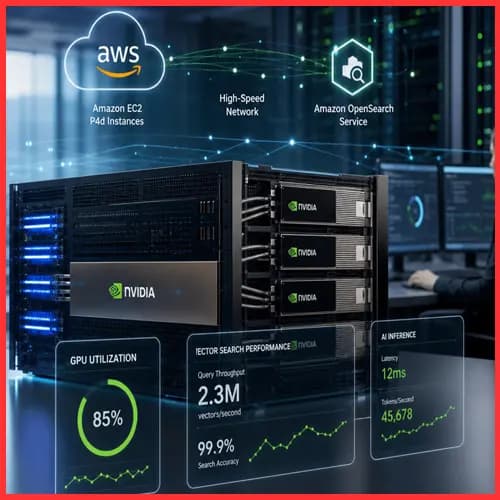
Software and data integration is expanding equally aggressively — NVIDIA Nemotron models remain available through Amazon Bedrock and SageMaker, cuDF is integrating with Amazon EMR for GPU-accelerated data processing, and cuVS is accelerating vector indexing in Amazon OpenSearch. Physical AI is another pillar, with Amazon Robotics adopting NVIDIA's Jetson, Omniverse, and Isaac for simulation and robot training.
The larger significance: AWS and NVIDIA are co-engineering virtually every layer needed to industrialize AI — compute, memory, networking, data, models, agents, and robotics — reflecting that GPU performance alone no longer determines AI economics at scale.