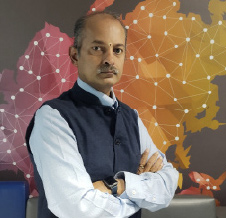


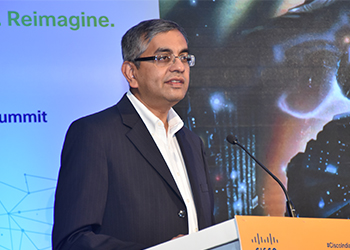
Cisco Systems has been working on securing and connecting digital networks across the globe and is looking closely at a digital transformation and changing its core strategy, from a focus on hardware, CISCO is keenly looking at software and its use cases across industries. Speaking about the war for talent and the growing need for people to skill themselves, V.C. Gopalratnam, senior vice president, IT and Chief Information Officer (CIO) at Cisco Systems said in his inaugural address in Goa, two day Cisco India summit. He further spoke about the importance of skilling oneself faster than ever before.
Gopalratnam spoke about, digital transformation is about the five elements - the network, working on the cloud model, leveraging the power of data, simplifying and automating, and building a great experience. All our activities in digital transformation is being driven by these tenants - both internally and externally and the future of technologies such as AI, ML to overtake human expertise. He says, Machines can do very well in different areas where rule based processes or jobs are involved. These are applicable to basic level jobs and tasks that do not require domain expertise and follow a set of rules and patterns.
Cisco is in a war for talent and the changes happening every day around us and our strong believe on the technologies we are working in such as, networking, collaboration, security and all our verticals, we are shaping the industry trends. But it is hard to attract and retain the best talent.
There are a few things we do, and the tried-and-tested method is education. We, therefore, invest in training and skilling, but that can only take you to a certain extent. The second thing is we have started to work in dynamic teams, where people can report to somebody, and at the same time work for somebody else in the organisation. This helps broaden perspectives. We also believe in experiential learning. We routinely create these small teams that can go off and do something for a while, like a rapid self-organised delivery team. The idea is to give people the opportunity to experience and work with new technologies.
Gopalratnam spoke about setting up a network of ‘CISCO thingQbator’ labs in five academic institutions in India, aimed at enhancing digital skills development and entrepreneurship among the student community in Indian Institute of Information Technology and Management, (IIITMK), Kerala, IIT-BHU Varanasi, Amrita University Coimbatore, Indira Gandhi Delhi Technical University for Women- Delhi and Trident Academy of Technology Bhubaneswar.
Secondly, we always look closely at Indian startups and do strategic and carefully-thought on investments into the startups and small companies at different stages. We look at multiple capabilities. While we have large engineering and R&D teams, we also look externally and there have been spin-offs, where we have taken few hundred people, unburdened them from the overhead of Cisco, asked them to go out and build something at scale quickly. Later, Cisco invests in the company and brings the technology back to the company. We have done over 200 such acquisitions. These are companies that generally plug a hole in our portfolio.
Cisco will support up to 20 organisations during the first year in two cohorts. Each selected startup will receive an innovation grant of Rs 10 lakh. In addition, the startup will have access to a set of mentors and technology experts from Cisco along with N/Core partners," he explained.
Spoke about the CSR initiatives, we are also supporting N/Core, an incubator for social sector startups, to launch N/Core tech - an exclusive track focussed on incubating early-stage non-profits that leverage digital technology to positively impact society. N/Core tech will primarily focus on incubating companies that are developing solutions in the areas of critical human needs, education, and economic empowerment, he added.
Lastly, Gopalratnam spoke about the launch of the Centre of Excellence (CoE) for Internet of Things (IoT) at R.V. College of Engineering in Bengaluru to give students digital skills and train them for jobs in the digital economy. Besides this, we have a 'Step Up for India – Spoken English Programme' that has benefited over 300 students from three government schools in Bengaluru. This program delivers structured spoken English classes to students in Grade 4 and 5 studying in government schools where the medium of instruction is the local language.

See What’s Next in Tech With the Fast Forward Newsletter








Tweets From @varindiamag
Nothing to see here - yet
When they Tweet, their Tweets will show up here.