

According to MORTH Road Accident Data 2017, India loses more than 1.5 lakh people to road accidents each year, which is equivalent to 400 lives a day. Delhi tops the list of cities with the highest road accident-related deaths. In 2017, more than 1500 people died in road accidents, which is equivalent to four deaths each day. The data further revealed that 37% of total accidents take place on junctions, 37% of the total road fatalities take place on junctions, and uncontrolled junctions account for 73% of fatalities at road junctions.
While authorities have started several initiatives to curb this unfortunate number of deaths in road accidents, the general awareness on how important traffic laws are for the safety of the road users is still quite low. Hence, Maruti Suzuki and Delhi Police are now implementing the city’s Red Light Violation Detection System (RLVDS) and Speed Violation Detection System (SVDS).
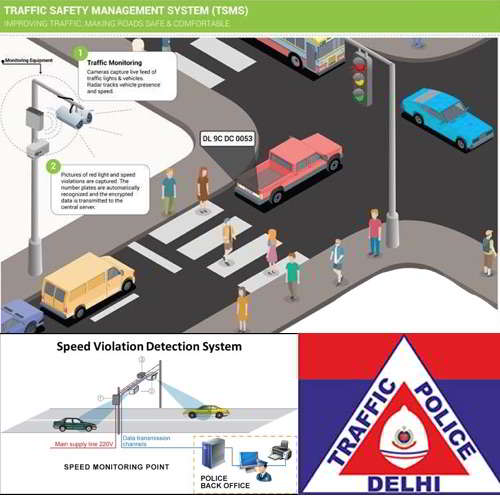
Delhi Police, in collaboration with Maruti Suzuki, announced the launch of a new traffic management system which will enable the force to detect traffic violators at any time and automatically send challans to them. Maruti Suzuki and Delhi Police are collectively implementing Red Light Violation Detection System (RLVDS) and Speed Violation Detection System (SVDS) in the city. The main objective of the new system is to eliminate human intervention and the subjectivity a traffic violation situation is put through. This means that now escaping a traffic violation like jumping a traffic light or over speeding will be nearly impossible.

The objective behind this project is to remove human intervention from the current challan system and help reduce traffic violations and thus fatalities and accidents. With the RLVDS and SVDS in place, traffic management should get more stringent as well as efficient. Escaping a challan along the corridor with RLVDS and SVDS active will be difficult as the cameras installed will take a picture of the offender's vehicle which will then act as proof and sent directly to them.
The new project has been kick-started in Delhi already and in its initial stage, it will cover a 14 km stretch along the ring road in Delhi – from Dhaula Kuan to Sarai Kale Khan. Over 100 HD cameras have been installed across 10 high traffic intensity junctions along the 14 km stretch.

The 10 high-traffic junctions with RLVDS and SVDS installed are Moti Bagh, Bhikaji Cama Place, Nauroji Nagar, Andrews Ganj, Moolchand, Lal Sai Market, Lajpat Nagar-Captain Gaur, Sriniwaspuri, Ashram and Sarai Kale Khan junctions. The Delhi Traffic Police will monitor the live feed from the cameras from its control room at Todapur Command Center at Delhi Traffic Police Headquarters in Naraina.
The objective behind this project is to remove human intervention from the current challan system and help reduce traffic violations and thus fatalities and accidents. With the RLVDS and SVDS in place, traffic management should get more stringent as well as efficient. Escaping a challan along the corridor with RLVDS and SVDS active will be difficult as the cameras installed will take a picture of the offender's vehicle which will then act as proof and sent directly to them.

See What’s Next in Tech With the Fast Forward Newsletter









Tweets From @varindiamag
Nothing to see here - yet
When they Tweet, their Tweets will show up here.