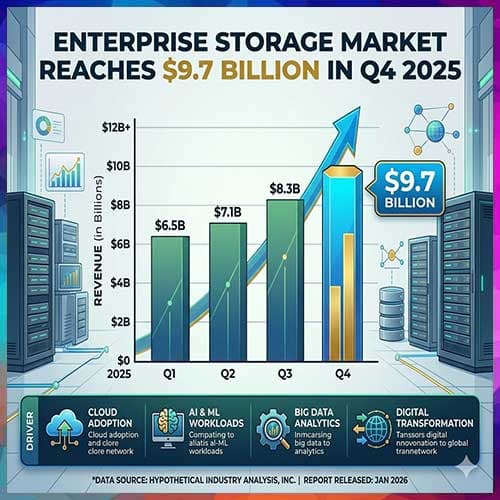
The global market for external enterprise storage systems generated $9.7 billion in revenue in the fourth quarter of 2025, growing 5.5% year over year, according to data from International Data Corporation (IDC).
The research firm said the market benefited from renewed corporate spending on delayed storage infrastructure upgrades, even as attention in the broader data center sector remained focused on the rapid expansion of server capacity for artificial intelligence workloads.
For the full year, global enterprise storage revenue reached a record $33 billion in 2025, representing 3.9% growth compared with 2024.
IDC said all-flash arrays remained the fastest-growing segment, with revenue rising 18.1% year over year as enterprises increasingly adopt flash-based storage for performance-intensive workloads.
Unexpectedly, traditional hard disk drive (HDD) arrays also recorded modest growth of 3.1%, while hybrid flash arrays declined 6.7% during the quarter.
Midrange systems—those with an average selling price between $25,000 and $250,000—continued to dominate the market. IDC said the segment grew 8.5% and accounted for 66% of total external storage revenue.
High-end storage systems priced above $250,000 grew 5.4%, while entry-level systems priced below $25,000 declined 6.9%.
Juan Seminara said enterprises are balancing the need to refresh storage infrastructure with rising component costs and evolving technology strategies.
He noted that demand in the coming year will depend on how organizations allocate capital spending across hardware, software, management platforms and consumption-based storage services.
Component price volatility has also influenced purchasing decisions. IDC said rising prices for solid-state drives (SSDs), hard disk drives and DRAM have prompted some companies to secure supply in advance, while others are reconsidering a mix of flash and traditional HDD platforms to control costs.
Regionally, China and the United States recorded the strongest growth, with revenue increasing 8% and 6.9% respectively in the quarter.
Growth in Europe, the Middle East and Africa (EMEA) reached 4.3%, while Latin America expanded 1.8%.
Markets in Japan remained nearly flat with 0.8% growth, while Asia-Pacific excluding Japan and China (APeJC) and Canada recorded slight declines.
Among vendors, Dell Technologies led the enterprise storage market with 23.7% revenue share, followed by Huawei with 12.6% share.
NetApp ranked third with 8.1% market share, while Everpure placed fourth with 7.1% share. IBM rounded out the top five with 6.3% share.
IDC noted that despite economic uncertainty and geopolitical tensions, enterprise storage spending is expected to remain stable as organizations continue investing in infrastructure needed to support growing data volumes and AI-driven workloads.
The research firm said the market benefited from renewed corporate spending on delayed storage infrastructure upgrades, even as attention in the broader data center sector remained focused on the rapid expansion of server capacity for artificial intelligence workloads.
For the full year, global enterprise storage revenue reached a record $33 billion in 2025, representing 3.9% growth compared with 2024.
IDC said all-flash arrays remained the fastest-growing segment, with revenue rising 18.1% year over year as enterprises increasingly adopt flash-based storage for performance-intensive workloads.
Unexpectedly, traditional hard disk drive (HDD) arrays also recorded modest growth of 3.1%, while hybrid flash arrays declined 6.7% during the quarter.
Midrange systems—those with an average selling price between $25,000 and $250,000—continued to dominate the market. IDC said the segment grew 8.5% and accounted for 66% of total external storage revenue.
High-end storage systems priced above $250,000 grew 5.4%, while entry-level systems priced below $25,000 declined 6.9%.
Juan Seminara said enterprises are balancing the need to refresh storage infrastructure with rising component costs and evolving technology strategies.
He noted that demand in the coming year will depend on how organizations allocate capital spending across hardware, software, management platforms and consumption-based storage services.
Component price volatility has also influenced purchasing decisions. IDC said rising prices for solid-state drives (SSDs), hard disk drives and DRAM have prompted some companies to secure supply in advance, while others are reconsidering a mix of flash and traditional HDD platforms to control costs.
Regionally, China and the United States recorded the strongest growth, with revenue increasing 8% and 6.9% respectively in the quarter.
Growth in Europe, the Middle East and Africa (EMEA) reached 4.3%, while Latin America expanded 1.8%.
Markets in Japan remained nearly flat with 0.8% growth, while Asia-Pacific excluding Japan and China (APeJC) and Canada recorded slight declines.
Among vendors, Dell Technologies led the enterprise storage market with 23.7% revenue share, followed by Huawei with 12.6% share.
NetApp ranked third with 8.1% market share, while Everpure placed fourth with 7.1% share. IBM rounded out the top five with 6.3% share.
IDC noted that despite economic uncertainty and geopolitical tensions, enterprise storage spending is expected to remain stable as organizations continue investing in infrastructure needed to support growing data volumes and AI-driven workloads.