
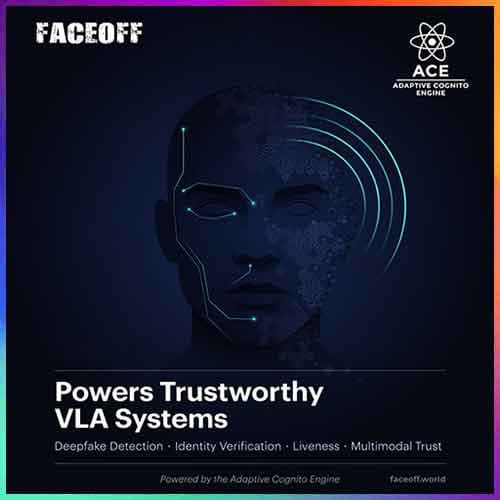
As Vision-Language-Action (VLA) systems gain the ability to perceive, reason, and act autonomously, trust becomes critical. The accuracy of their decisions depends on the authenticity of the data they consume.
FaceOff Technologies provides the trust layer for autonomous AI through deepfake detection, synthetic identity verification, liveness checks, behavioral intelligence, and multimodal trust scoring. Its Adaptive Cognito Engine (ACE) validates inputs, detects manipulation, and assesses risk in real time.
By ensuring that AI systems act on verified information, FaceOff enables secure deployment of AI agents, robotics, industrial automation, and digital workforces with greater confidence, governance, and accountability.
FaceOff Technologies complements VLA platforms through:
â— AI-Powered Identity Verification: Ensures that VLA systems interact only with verified humans, devices, and digital entities before executing actions.
â— Deepfake & Synthetic Media Detection: Validates images, videos, and voice inputs consumed by VLA models, preventing manipulation through AI-generated content.
â— Multimodal Trust Scoring: Combines facial, voice, behavioral, and contextual signals to assess authenticity before an AI agent acts.
â— Behavioral Intelligence & Risk Detection: Identifies anomalies, suspicious intent, and synthetic identities that could mislead autonomous systems.
â— Digital Trust Infrastructure: Establishes governance, audit trails, and accountability for AI-driven decisions, supporting compliance and responsible AI deployment.
â— Human-in-the-Loop Assurance: Provides an additional trust layer for high-risk actions, ensuring critical decisions are reviewed when required.
Powered by its proprietary Adaptive Cognito Engine (ACE), FaceOff delivers an enterprise-focused approach to security. Instead of focusing solely on passive image verification, it processes real-time liveness checks, behavioral biometrics, and multi-modal forensics. By validating the authenticity of the humans, devices, and data inputs interacting with a VLA ecosystem, it acts as a gatekeeper that ensures autonomous models never execute physical or financial decisions based on manipulated or synthetic information.
VLA Technology Advancement & Trust Integration
To understand how this integration protects modern enterprise systems, we can look at how standard VLA architectures compare against a FaceOff-secured environment across major technical capabilities:
|
Capability |
Standard VLA Infrastructure |
FaceOff-Secured VLA Ecosystem |
|
Input Processing |
Ingests multi-modal inputs blindly, exposing the system to injection attacks. |
Uses Multi-AI Fusion to parse and validate inputs across 8 forensic models before execution. |
|
Media Authentication |
Reliant on external tools or post-incident analysis to flag deepfakes. |
Implements Real-time Synthetic Fraud Detection to catch audio-video mismatches and GAN outputs instantly. |
|
Behavioral Evaluation |
Minimal; primarily focused on tracking and spatial mapping. |
Continuously evaluates user gaze, micro-expressions, and voice stress for anomaly detection. |
|
Security Architecture |
Fragmented across multiple third-party fraud, compliance, and API vendors. |
Follows a Single Trust OEM strategy, centralizing governance, privacy, and identity scoring. |
|
Deployment Model |
Heavily dependent on public cloud APIs, increasing data-leakage and latency risks. |
Deploys on-premise or at the edge via the FOAI Edge Box, preserving full data sovereignty. |
Building Digital Trust in the Age of AI is a detailed interview detailing how traditional identity systems struggle in the modern landscape and how real-time trust infrastructures can verify human authenticity across automated workflows.