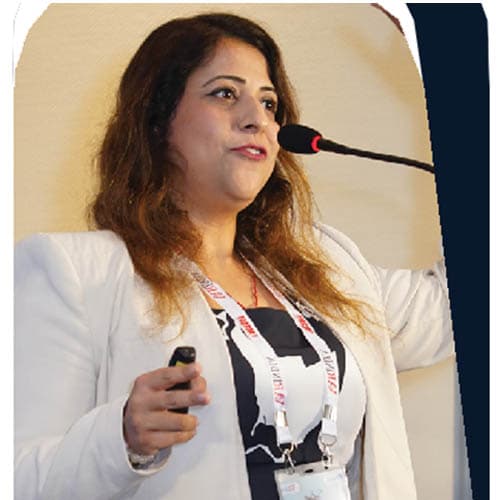
PRIYANKA ARORA
SOLUTION SALES LEAD - MICROSOFT
“Both cyber security and AI complement each other today. Cybercrimes have grown 5x. If you look at the projected annual cost of cyber crime, it is $10.5 trillion. It could become the third largest economy for that matter. In fact, cybercrimes basically include data theft, compromised credentials, business losses, businesses getting disrupted, reputational damage of the organizations, and so on. This figure is very daunting at this point of time. Let us look at some other facts. The median time for an attacker to penetrate inside the customer environment has reduced even further. It was one hour 12 minutes but currently powered by Gen AI, it has come down to less than 32 minutes. If we compare the last two years, the password attacks per second has surged from a 4000 to a 7000. Threat actors which are being tracked by Microsoft has also increased from a 300 to a 1500+. During Operation Sindoor, there was an organization which was tracked down in Bihar which was committing phishing and ransomware attacks on organizations. And all of these threat actors are operating in the Indian sub-continent. Having said this, security has become a serious conversation today. Phishing and ransomware attacks are increasing as we speak.
Today, organizations are facing a challenge of disconnected tools. A typical organization is using between 6-15 different tools to protect every single thing - their endpoints, devices, data, cloud, and so on and so forth. Secondly, there is a dearth of cyber security professionals. Gen AI is certainly for good, but Gen AI is also supporting threat actors in terms of creating better impersonation attacks, and create malwares which can be embedded in an email or a link. This is why we need to be ahead of these threat actors as defenders and our defense mechanism has to be much quicker. So AI is certainly expanding the attack surface with Gartner estimating that by the end of 2026, Gen AI will basically account for 10% of all the data which is being produced, and all of that could become vulnerable if we are not protected adequately. It is important to defend our email endpoints, devices, apps, and cloud data. But do we introspect and realize that we are defending all of these in silos. Threat actors are approaching us in a very connected fashion, and they are traversing across our network. For example, a user gets a phishing mail or clicks on a link which has a malicious code, and then the identity gets compromised. The attack then moves towards their endpoint device before traversing across the network. The threat actor can literally remain in the network as much as they want without being identified. We literally suffer with alert fatigue because we have created silos.”