
Global wearable device shipments crossed the 200-million mark in 2025, growing 6% year-on-year, as competition at the top intensified and the market continued its shift from hardware-led growth to ecosystem-driven strategies, according to new data from Omdia.
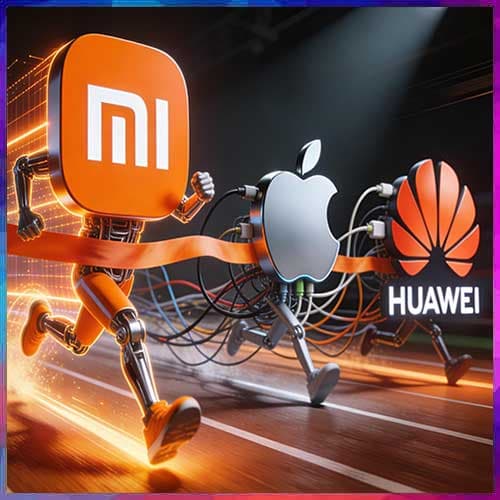
Xiaomi emerged as the world’s largest wearable vendor for the first time since 2020, capturing an 18% share of global shipments. The Chinese company edged past Apple, which finished 2025 in second place with a 17% share, while Huawei followed closely with 16%. The narrow gap between the top three vendors highlights a market entering a phase of tighter competition and consolidation.
Together with Samsung and Garmin, the top five vendors accounted for a growing share of global shipments, underscoring the importance of scale, ecosystem depth, and differentiated services in an increasingly mature category.
Omdia said Xiaomi’s return to the top was driven by a broad, multi-category strategy rather than reliance on a single flagship product. Its fitness bands continued to deliver volume at the mass-market level, while its basic smartwatches—supported by in-house chip development and deeper ecosystem integration—helped the company move up the value chain. Apple, meanwhile, maintained its dominance in the premium segment, supported by strong customer loyalty and advanced health features, including blood-pressure monitoring and expanded connectivity capabilities. Huawei consolidated its mainstream position with a wide product portfolio while increasing its focus on professional sports tracking and medical-grade health applications.
The report noted that wearables are increasingly transitioning from a hardware-centric business to one built around data, services, and subscriptions. AI-driven insights, continuous health monitoring, and professional training tools are emerging as key revenue drivers as hardware margins come under pressure from rising component costs. Vendors are also experimenting with new form factors, including reduced-screen and screenless designs, to improve comfort and enable continuous data collection.
Looking ahead, Omdia expects the global wearables market to grow at a modest single-digit pace in 2026. While shipment volumes are expected to rise gradually, future growth will depend more heavily on advances in on-device AI, professional-grade health tracking, and ecosystem integration. Breakthroughs in monitoring key physiological metrics—such as blood glucose and blood pressure—are expected to play a critical role in driving meaningful upgrade cycles, particularly in the smartwatch segment.
As competition tightens, Omdia said long-term success in wearables will increasingly depend not on shipment scale alone, but on the ability to combine AI capabilities, recurring service revenue, and seamless cross-device experiences.
Xiaomi emerged as the world’s largest wearable vendor for the first time since 2020, capturing an 18% share of global shipments. The Chinese company edged past Apple, which finished 2025 in second place with a 17% share, while Huawei followed closely with 16%. The narrow gap between the top three vendors highlights a market entering a phase of tighter competition and consolidation.
Together with Samsung and Garmin, the top five vendors accounted for a growing share of global shipments, underscoring the importance of scale, ecosystem depth, and differentiated services in an increasingly mature category.
Omdia said Xiaomi’s return to the top was driven by a broad, multi-category strategy rather than reliance on a single flagship product. Its fitness bands continued to deliver volume at the mass-market level, while its basic smartwatches—supported by in-house chip development and deeper ecosystem integration—helped the company move up the value chain. Apple, meanwhile, maintained its dominance in the premium segment, supported by strong customer loyalty and advanced health features, including blood-pressure monitoring and expanded connectivity capabilities. Huawei consolidated its mainstream position with a wide product portfolio while increasing its focus on professional sports tracking and medical-grade health applications.
The report noted that wearables are increasingly transitioning from a hardware-centric business to one built around data, services, and subscriptions. AI-driven insights, continuous health monitoring, and professional training tools are emerging as key revenue drivers as hardware margins come under pressure from rising component costs. Vendors are also experimenting with new form factors, including reduced-screen and screenless designs, to improve comfort and enable continuous data collection.
Looking ahead, Omdia expects the global wearables market to grow at a modest single-digit pace in 2026. While shipment volumes are expected to rise gradually, future growth will depend more heavily on advances in on-device AI, professional-grade health tracking, and ecosystem integration. Breakthroughs in monitoring key physiological metrics—such as blood glucose and blood pressure—are expected to play a critical role in driving meaningful upgrade cycles, particularly in the smartwatch segment.
As competition tightens, Omdia said long-term success in wearables will increasingly depend not on shipment scale alone, but on the ability to combine AI capabilities, recurring service revenue, and seamless cross-device experiences.