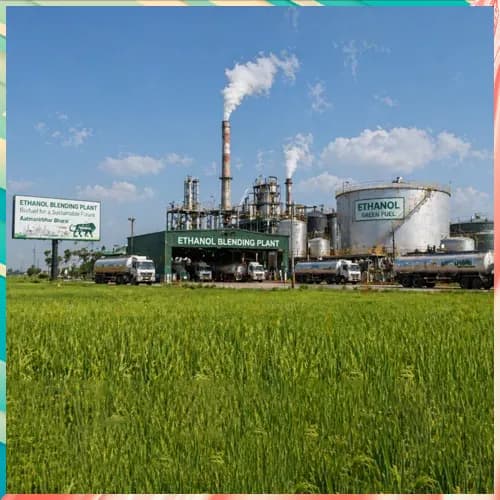
India’s push to mix ethanol with petrol, seen as a fix for the country’s clean energy strategy, is deepening the country’s water crisis. Ethanol blending means mixing a plant-based alcohol, called ethanol, into petrol to reduce India’s dependence on imported crude oil. The country has been aggressively scaling this programme, and rice has become a key raw material. But at the heart of the problem are crops that already consume more water than almost anything else grown in India, like maize, sugarcane, grain, and rice.
The government allocated 52 lakh tonnes of rice for ethanol production in 2024-25, and is now targeting 90 lakh tonnes in 2025-26. To free up this grain, it plans to reduce the share of broken rice distributed to the poor under the public distribution system from 25% to 10%, diverting the savings straight to distilleries for use in ethanol blending.
But the problem is - producing one litre of ethanol from rice requires around 10,790 litres of water, which includes water used for irrigation during cultivation, according to Food Secretary Sanjeev Chopra, who shared the data at a global conference in Delhi in 2024.
Most water used in rice-based ethanol comes from cultivation, not processing. Growing 1 kg of rice needs about 3,000-5,000 litres of water. Around 2.5-3 kg of rice produces one litre of ethanol, putting the total water footprint at approximately over 10,000 litres.
By comparison, maize requires about 4,670 litres and sugarcane around 3,630 litres per litre of ethanol.
The conversion ratio makes this worse. One kilogram of rice requires roughly 3,000 litres of water to grow, yet one tonne of rice yields only about 470 litres of ethanol, making rice one of the most water-intensive fuel sources imaginable. The push for ethanol blending is happening against a deeply alarming backdrop.
NITI Aayog’s Composite Water Management Index (CWMI) has warned that by 2030, groundwater in 21 major cities, including Delhi, Bengaluru, and Chennai, could reach zero.
India’s total ethanol production capacity stands at 1,822 crore litres, with a disproportionate share concentrated in already water-stressed states.