
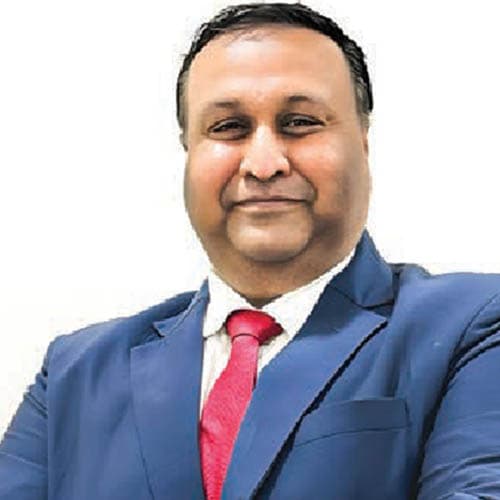
AMIT AGRAWAL
PRESIDENT, TECHNO DIGITAL
“If India wants sovereign AI, it must first build robust infrastructure and enable a local ecosystem. Large language models may process tokens, but tokens translate into IT power, thermal load, electrical stability, robust network, and geographical spread. If those fundamentals are weak, no amount of GPU procurement will make a data center AI-ready. We are redesigning architecture around this reality. AI workloads demand predictable power paths, higher-density tolerance, liquid cooling readiness, and modular scaling blocks that evolve without structural redesign every cycle. The real design question is no longer ‘How many racks?’ but ‘How stable is the energy-to-compute conversion under sustained load?’ Our 36 MW Chennai facility reflects this approach. Hybrid cooling using high- efficiency centrifugal chillers with adiabatic cooling towers delivers a PUE of 1.35 while reducing water consumption by up to 75%, demonstrating that density and sustainability can coexist when engineered correctly.
AI is also reshaping topology. Training belongs in concentrated, resilient core environments, while inference belongs closer to users. A distributed model is therefore not optional. Our strategy combines hyperscale campuses with a 102-city pan-India edge footprint to address latency, governance, and data gravity. Core and edge are interdependent layers of the same compute fabric, orchestrated through hybrid cloud models. The harder challenge is balance. Rapid expansion without energy discipline becomes fragile; high density without thermal maturity becomes inefficient; renewable ambition without storage becomes unreliable. Sustainability cannot live in ESG reports-it must live inside the electrical room. Water-efficient cooling, storage- backed renewable integration, and disciplined PUE targets are engineered at inception, not retrofitted.
Over the next three years, competitiveness will be defined by smarter power systems, advanced liquid and immersion cooling technologies, direct liquid cooling (DLC), AI-driven infrastructure management, dynamic workload orchestration across core and edge, and deeper integration of renewables with energy storage. More GPUs alone will not create advantage. The real risk ahead is not underinvestment, it is overconfidence. Building rigid, one-dimensional AI capacity based on current density assumptions can create stranded assets. Infrastructure must remain adaptable because AI workloads will evolve faster than real estate cycles. India’s sovereign AI future will not be determined by who builds the largest campuses, but by who builds infrastructure that absorbs volatility, converts energy efficiently into compute, and sustains reliability at national scale.”