Backed by fast-tracked projects, skilled talent development, and rising global collaboration, India is positioning itself as a competitive hub for semiconductor manufacturing and advanced chip design.
India is set to witness a significant expansion in its semiconductor manufacturing capacity, with Union Electronics and IT Minister Ashwini Vaishnaw announcing that four semiconductor plants are expected to be operational by 2026, followed by two more in 2027. The country’s first semiconductor fabrication unit is projected to be ready in Dholera by 2028.
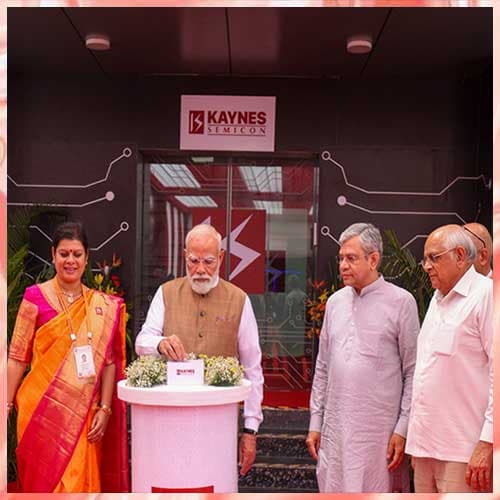
The announcement came after Prime Minister Narendra Modi inaugurated a new OSAT (Outsourced Semiconductor Assembly and Test) facility by Kaynes Semicon in Sanand, Gujarat. The minister highlighted that this marks the second semiconductor plant inaugurated within a short span, following Micron Technology’s facility launch earlier this year, with a third plant expected to be inaugurated in July.
Vaishnaw underscored the rapid pace of development, noting that the Sanand facility progressed from foundation to production readiness in just 14 months, reflecting improved execution capabilities within India’s semiconductor ecosystem.
Expanding ecosystem and talent pipeline
The minister emphasized that India’s semiconductor ambitions are being supported by the parallel development of a comprehensive ecosystem, including machinery, specialty chemicals, gases, and testing infrastructure. He noted that nearly 60,000 engineers across 315 universities have been trained in advanced chip design tools such as Synopsys and Cadence, contributing actively to domestic design capabilities.
According to Vaishnaw, chips designed by Indian engineers are already being manufactured at a laboratory in Chandigarh. He also pointed out that global technology leaders including Nvidia, AMD, and Intel are undertaking advanced chip design work in India, including work on cutting-edge 2-nanometre technologies.
“Our approach is design in India and make in India,” he said, stressing the importance of competitiveness in both cost and quality to establish a strong global presence.
Gujarat positioned as emerging semiconductor hub
Gujarat Chief Minister Bhupendra Patel highlighted the state’s growing prominence in high-technology sectors, stating that regions such as Sanand and Dholera are poised to evolve into a semiconductor hub.
He noted that Gujarat is strengthening its position across sectors such as artificial intelligence, green hydrogen, and renewable energy, supported by policy initiatives, improved logistics infrastructure, and investments in education. The state has also introduced semiconductor-focused courses and established advanced material research facilities to build a skilled workforce.
Looking ahead, Vaishnaw reiterated that under the Semicon 2.0 programme, the government aims to localise the entire semiconductor supply chain. India is targeting a position among the top six global semiconductor nations by 2032, and among the top three by 2047.