
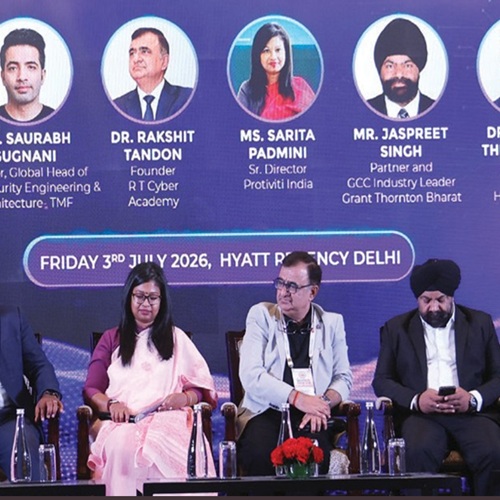
A panel discussion themed “Post Quantum Security: The Race Against Time” was moderated by Gyana Swain, Consulting, Editor, VARINDIA. The panelists who joined the session were Rohit Ponnapalli, CISO- Envoy Global; Dr. Rakshit Tandon, Founder- R T Cyber Academy; Sarita Padmini,Sr. DirectorProtiviti India; Jaspreet Singh, Partner and GCC Industry Leader- Grant Thornton Bharat; Dr. Harsha Thennarasu, Founder & CISO-HKIT Security Solutions and Garvit Sharma, CTO- Athenian Tech.
Gyana Swain set the stage for the discussion by highlighting the importance of post-quantum security and examining how today's CIOs are preparing for it. “When we discuss about or talk about quantum computing, we used to think this is a future technology. But for the panelists and the cyber security professionals who are sitting here, they have a very tough tasks to do. They are already working on quantum computing because for them the future will be decided what they are doing or acting upon right now. For CIOs, the future of quantum computing depends on the actions they take today,” he said.
Dr. Rakshit Tandon, pointed out that businesses are still in the awareness phase and talking and discussing about quantum computing, but the threat is inevitable. “Looking at the past incidences, we have seen a lot of data breaches, and if we look at the approach of these notorious hackers, it is ‘harvest now and decrypt later’. So now they have started this phase. They are already started dumping your encrypted data, and they are waiting for the Q-Day, the day when they will be able to break all these encryptions, whether it is RSA or ECC, and they will be misusing your data. In other words, quantum computing threatens cybersecurity by rendering foundational encryption algorithms (like RSA and ECC) obsolete. So I think the threat is immediate, and immediately the CISO should start identifying their crypto assets. They should start working on crypto agility and how to modify their algorithms with the minimum expenditure in coming future.”
 |
| (L-R): Gyana Swain, Consulting, Editor, VARINDIA; Rohit Ponnapalli, CISO- Envoy Global; Sarita Padmini, Sr. Director- Protiviti India; Dr. Rakshit Tandon, Founder- R T Cyber Academy; Jaspreet Singh, Partner and GCC Industry Leader- Grant Thornton Bharat; Dr. Harsha Thennarasu, Founder & CISO-HKIT Security Solutions and Garvit Sharma, CTO- Athenian Tech |
Jaspreet Singh cited an example he read recently, “I recently read that an iPhone secured with a six-digit PIN could, in theory, be unlocked using brute-force methods and today's available computing power in roughly seven to eight hours by systematically testing every possible PIN combination. Anybody wants to take a guess using quantum tech, which is available today in developed countries, how much time will it take? 21 seconds is what they are claiming. If we look at all our infrastructure from an IT perspective and legacy systems that we have in our country, including hard-coded passwords. Are we equipped or is our preparedness enough for the crisis ahead? That only time can tell.”
According to Dr. Harsha Thennarasu, any new technology needs a minimum of five to 10 years to accommodate to or adopt it. “But at this point of time, we are in need of quantum security because quantum is going to break any encryptions and the outcome can be as disastrous as anyone can expect. USA’s NIST (National Institute of Standards and Technology) has already finalized the framework for quantum computing. The government of India also has allocated ₹6,003.65 crores for the 2023–2031 period. When you talk about the industry, corporate have started adopting it, but where are the small medium enterprises? How they are going to adapt to this big change or are they going to lose their big business by succumbing to threats by the quantum attacks? So that is the biggest challenge at this point of time.”
Sarita Padmini stated that business organizations are yet to discuss about or bring the topic of quantum computing to the boardroom. “I would suggest it's high time now. If we are not starting the journey right now or begin discussion around how to plan the road ahead, it may be too late before we finally wake up to this realization. Until now, the elephant in the room was AI. Mythos happened and no one was ready. So tomorrow, the Q-Day would happen and nobody would be ready. It is very essential that the organizations understand and align their quantum plans with their business resiliency strategies. The skillset needs to be developed within the organization at this point of time because it would not be something that we cannot develop within a year. It may take another five to 10 years for the organization to develop that skillset.”
Rohit Ponnapalli contradicted a bit and said, “So far, quantum technology is not even an agenda in the boardrooms. We are still trying to assess the kind of attacks we see from implementing AI or what kind of breaches we see by incorporating third-party SaaS platforms. But definitely, they have a clarity that over a period of time quantum will be the way forward. There are a few industries who are definitely interested in understanding the implementation of quantum technology, followed by the security controls around how do we safeguard our data. But from my point of view, right now the challenge is AI.”
Garvit Sharma said that Shor's algorithm was developed in 1994, and before that there was RSA 2048, an asymmetric cryptographic algorithm running for quite a decade. “The challenge is that quantum will break Shor's algorithm and RSA 2048 in sometime. But can it break it now? It is not possible and will take ages for quantum to break RSA 2048. The threat is definitely there 10 – 15 years from now, when we would have quantum computers with 20 million qubits, and they can break RSA within few hours.”

See What’s Next in Tech With the Fast Forward Newsletter





Tweets From @varindiamag
Nothing to see here - yet
When they Tweet, their Tweets will show up here.