
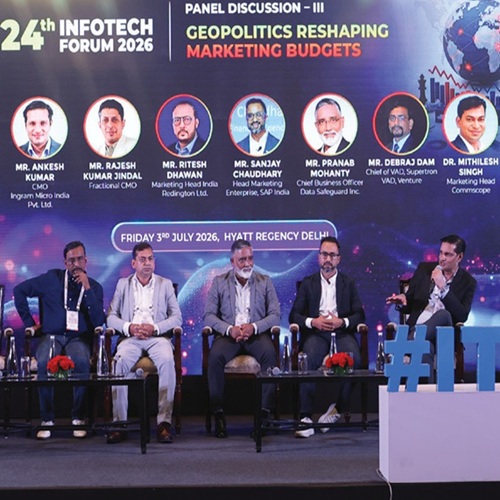
The last panel discussion of the day, themed “Geopolitics Reshaping Marketing Budgets”, was moderated by S Mohini Ratna, Editor, VARINDIA. Opening the discussion, she said, “Geopolitical shifts evolving trade policies, supply chain challenges and the rapid rise of AI are reshaping how organizations plan and prioritize their marketing investments. Today's CMOs are moving beyond traditional brand building towards data driven ROI focused and agile marketing strategies.”
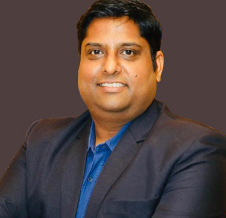
Ankesh Kumar, Chief Marketing Officer- Ingram Micro India Pvt. Ltd.
"The main effect of the geopolitical tensions is how they are affecting the overall economy. There is price rise, supply chain issues, and we are already facing chip shortages for infrastructure projects. We also have uncertainties around the ongoing geopolitical situation. There are tariff issues, there are issues with China, and eventually all of this is affecting the overall economy, the supply chain, and demand.
The moment demand is affected, it has a trickle-down effect on the marketing budget as well. There is not much change in terms of reduction or any major impact, but there is a lot of uncertainty when it comes to planning. In the middle of all this, we are trying to figure out how we are going to adopt AI and automation. So, there are many things happening around.
So there is uncertainty for sure, and it will settle down once we get more clarity as things progress."
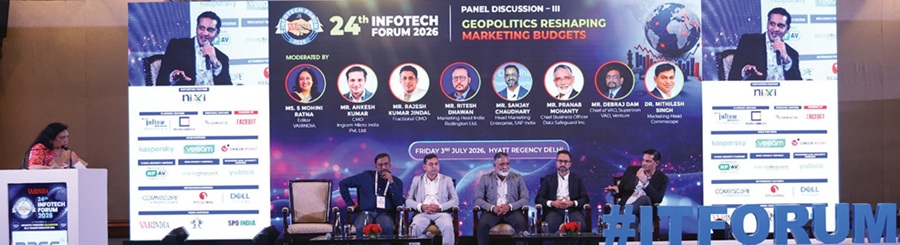 |
| (L-R): S Mohini Ratna, Editor, VARINDIA, Debraj Dam, Chief of VAD, Supertron VAD Venture, Dr. Mithilesh Singh, Marketing Head, Commscope India Pvt Ltd., Pranab Mohanty, Chief Business Officer, Data Safeguard Inc., Sanjay Chaudhary, Head of Marketing Enterprise, SAP India, and Ankesh Kumar, Chief Marketing Officer, Ingram Micro India Pvt. Ltd. |
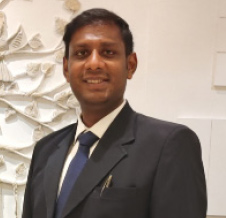
Debraj Dam, Chief of VAD, Supertron VAD Venture
"The marketing budget scenario is dynamic right now for most organizations, whether they are manufacturing companies, OEMs, distributors, or channel partners. As leaders, we no longer focus only on metrics like clicks; our priority is the customer lifecycle. We have to focus on the customer lifecycle and long-term value. It
is very important that the money we spend on marketing translates into customer satisfaction. If we own one customer, we must ensure that we provide prompt service, continue to promote our product. We also need to ensure that that the customer to be in our custodian for a long time as a value propositions."
Pranab Mohanty, Chief Business Officer- Data Safeguard Inc.
"Any crisis always puts pressure on the CMO's marketing strategy, but during geopolitical crisis, it also adds pressure on supply chain management. For companies operating globally, cost becomes a much bigger challenge. When costs increase, organizations naturally start cutting expenses, and marketing is often seen as a soft target. However, marketing is also one of the most essential business functions. In such a scenario, it is very important that marketing spending is treated as an investment. The focus should be on where to invest. Instead of investing in customer acquisition, organizations should invest more in retaining existing customers and generating recurring business from them. That approach is far more effective in helping businesses navigate the crisis."
Sanjay Chaudhary, Head Marketing Enterprise, SAP India
"If we look back, every generation has had one technology innovation that transformed the way we live and work. AI is different because it is changing everything in terms of the how work is getting done. Earlier, the conversation around AI was about improving efficiency, but today organizations are focusing on how they can bring more revenue generation through AI. the race to AI-driven ROI is really intensifying. AI helps identify the right signals, enables mass personalization, analyzes historical trends, and combines internal and external realities, including geopolitical factors, to make marketing more targeted. This enables account-based marketing, faster execution, and maximum ROI from marketing investments."
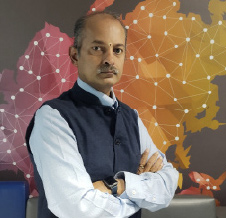
Dr. Mithilesh Singh, Marketing Head- Commscope India Pvt Ltd.
"Geopolitics has a big impact on marketing because the moment the map moves, money moves with it. Tensions, conflicts, tariffs, and supply chain disruptions affect product launches and reduce marketing budgets, shifting planning from annual budgets to agile, quarterly, scenario-based programs. There is greater emphasis on local sourcing, national pride campaigns, and consistent investment in corporate reputation and public relations. AI is playing a big role, especially in B2C, but in B2B, multi-million-dollar deals are built on relationships. People trust people, and sales happen through human connections. So we should not forget the importance of human relationship, it is very critical."

See What’s Next in Tech With the Fast Forward Newsletter




Tweets From @varindiamag
Nothing to see here - yet
When they Tweet, their Tweets will show up here.