

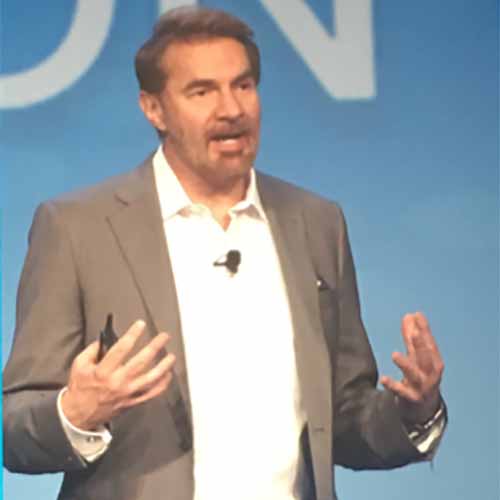
Erik Brynjolfsson is Director of the MIT Initiative on the Digital Economy, Professor at MIT Sloan School, and Research Associate at NBER,spoke during the Guru session of Dell Technology World 2019 in las vegas,USA.
Brynjolfsson was among the first researchers to measure the productivity contributions of information and community technology (ICT) and the complementary role of organizational capital and other intangibles. His research also provided the first quantification of the value of online product variety, often known as the “Long Tail,” and developed pricing and bundling models for information goods.
Erik spoke on how the technology and machines and humans can all work together. We are, I think, in the early stages of an important technological revolution, that is changing all of the economy, and society. But what's important is not just what the technology can do, but the way we respond to it, we take advantage of that technology. And right now, technology is not the bottleneck.
It's our skills, our institutions, and the way we respond to it. And this triple revolution minute talk to you about has precursors in earlier technological revolution that we learned a lot from them. First is about 100 years ago, the big technology that people are going to conferences about was electricity. Electricity was revolutionising factories and services. But what's surprising when you look at the research record, is that productivity did not increase as they introduced that electricity. It took them 30 to 40 years before you saw significant productivity improvements. 34 years, that's about how long the manager used to live, or die. Why did it take so long? Well, it's because the factories before electricity were structured around steam engines, sometimes watermill, the big central power source and then pulleys crank shafts drove all of the machinery when they introduced electricity. What did they do? Well, they took out the steam engine. And they put the biggest electric motor they could inside of it, like factories, like this big electric motor in the middle started big on sort of the middle. And still the same police and crankshaft driving machinery, did that really boost productivity. Not a whole lot, it really wasn't a whole lot different. So Fair enough, they were retrofitting factories, that they started building brand new factories from scratch, what did the new factories have like? It is all about transformation happens over a period of time.

Erik says by giving the example, there are certain amazing and newer technology into McAfee and I call it the triple revolution. Because there's a rebalancing between mind machine to big data and artificial intelligence. There's a shift from products to platforms as digital platforms become more powerful and there's some weird and wonderful economics of two sided networks that are going to explain. Last but not least, is a shift from the Core to the crowd, crowd based innovation and decision making that has led to some phenomenal results using these digital platforms.Good news, but also challanges : Digital progress makes the economic pie bigger. But there is no economic law that everyone,or even most people,will benefit.
There's a big data set of 14 million images called image net that they paid me and others put together and it used to be back in 2010. Machines that blue eyes were really pretty bad. But now as you can see, machines have 97 98% performance on these image recognition task. And by comparison, humans were good, but we're only about 95%. That steep part of the curve, which certainly gets really better, around 2011 -12-13.
There are start-ups out of MIT and elsewhere that are working on those in factories, robots, like Baxter, and many other robots are now doing tasks that only humans used to do. Baxter works 24 hours a day, seven days a week, for less than $4 an hour. In fact, he's already obsolete been replaced by some better versions of the robots, and not all look like human dinner. Here's a cheetah that my MIT colleague signed by Kim puts together I saw him running laps around the field house of MIT. Says Brynjolfsson.
Lastly, he spoke on how seven out of seven mark gets the Chinese companies including Tencent and Alibaba, for they have been really been phenomenally successful at leveraging digital platforms. So this is fitting good from a church technology. But there's still some room for startups to use it and your public companies to join the platforms. How does apples work with a start of a platform is network effects. Erik says, I think everyone in this room understands the power of networks and the triple revolution that's driving the changes mind machine product platform for and proud, each of them based on some amazing technologies, but also some fundamental transformations. Now, what does this mean for society? Well, the good news I want to emphasize this first is that it just makes the pie bigger. We are never been wealthier continental have less poverty than ever before. Says Erik.

See What’s Next in Tech With the Fast Forward Newsletter






Tweets From @varindiamag
Nothing to see here - yet
When they Tweet, their Tweets will show up here.