
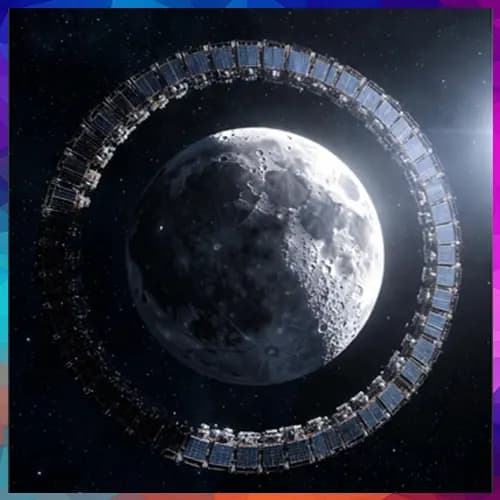
Proposed by Shimizu Corporation, the ambitious lunar project envisions a massive solar belt encircling the Moon, using robotics and wireless transmission to deliver uninterrupted clean energy to Earth on an unprecedented scale.
A futuristic concept from Shimizu Corporation is drawing global attention for its potential to reshape how energy is generated and distributed. Dubbed the “Luna Ring,” the proposal outlines the creation of a vast solar power belt around the Moon that could transmit clean energy back to Earth.
The project envisions a continuous ring of solar panels along the Moon’s equator, spanning roughly 11,000 kilometres in length and about 400 kilometres in width. Positioned in space, the system would benefit from uninterrupted sunlight, free from atmospheric disturbances, weather changes, or night cycles that typically affect solar power generation on Earth.
Space-based solar to meet global demand
Unlike terrestrial solar installations, which face fluctuations due to environmental conditions, the lunar surface offers a stable and consistent source of sunlight. This could enable the Luna Ring to generate an estimated 13,000 terawatts of electricity—far exceeding current global energy consumption.
The energy produced would be converted into microwaves or laser beams and transmitted wirelessly to receiving stations on Earth. These facilities would then convert the signals back into electricity and feed it into existing power grids, potentially ensuring a constant and reliable supply of renewable energy.
If successful, the concept could significantly reduce dependence on fossil fuels and help address long-term global energy challenges.
Robotics to lead lunar construction
Given the scale of the project, construction would rely entirely on advanced robotic systems rather than human labor. These autonomous machines would be designed to operate in the Moon’s harsh environment, carrying out tasks such as mining lunar soil, processing materials, and assembling solar infrastructure.
Heavy-duty robots would also handle transportation and installation across vast distances, enabling the gradual development of the solar ring. Future missions by agencies like the Japan Aerospace Exploration Agency and NASA are expected to play a key role in advancing the robotics and technologies required for such ambitious projects.
While still at a conceptual stage, the Luna Ring reflects how emerging innovations in space engineering and renewable energy could redefine the future of global power generation.