
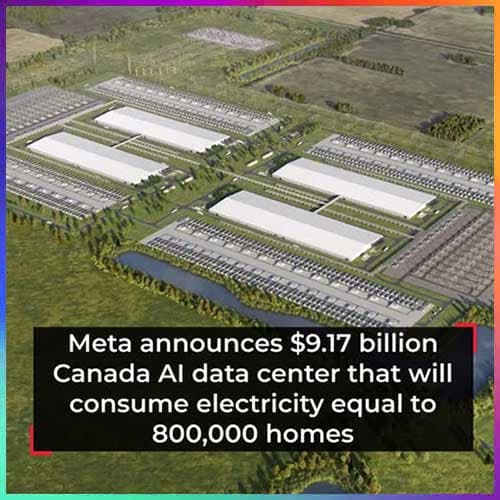
Meta revealed plans to set up a massive new data center in Alberta, Canada worth C$13 billion (approximately US$9.17 billion). The project comes as part of the company's ongoing investment in artificial intelligence (AI) infrastructure.
The data center will be built in Sturgeon County with an initial power capacity of 1 gigawatt (GW), which can be scaled up to 1.8GW to support growing AI computing demands.
Once operational, the facility is expected to consume electricity comparable to the annual usage of nearly 800,000 homes, underscoring the significant energy requirements of next-generation AI infrastructure.
Several factors have influenced Meta’s decision to build the data center in Alberta. The province offers abundant natural gas resources, relatively low electricity costs, and a cooler climate that helps reduce the energy required to cool large-scale server facilities. Alberta has also been actively courting investments from global technology companies, with provincial officials confirming that several other large data centre proposals are currently under review.
"This is the first of its kind, the first of its size, the first of its scale, but it won't be the last," Alberta Technology Minister Nate Glubish said during the announcement.
The facility's massive energy demand has emerged as one of the project's most closely watched aspects. Meta estimates the data centre will consume electricity equivalent to the power used by approximately 800,000 homes. To meet this demand, the company said it will fund new power generation capacity and grid infrastructure upgrades rather than relying solely on Alberta's existing electricity network.
As part of this strategy, Meta has partnered with Alberta-based Pembina Pipeline, which is developing a natural gas-fired power plant in Sturgeon County. The facility is expected to come online later this decade and will supply electricity to the data centre under a long-term agreement. Until then, Capital Power will provide 250 megawatts of electricity from its existing natural gas-fired generation assets.
The company says it will offset the electricity used by the site through investments in clean and renewable energy. It also said the facility will use a closed-loop liquid cooling system designed to recycle cooling liquid, reducing overall water consumption. According to Meta, the site's total water use will be lower than that of a typical golf course.
Despite these commitments, environmental groups have raised concerns about the project, arguing that the rapid expansion of AI-driven data centres could intensify pressure on energy resources and water supplies.
"We need a moratorium on mega-data centers until we have legislated environmental and human rights protections on AI," said Keith Stewart of Greenpeace Canada.