The new platform moves beyond traditional app-centric computing, leveraging AI agents and Android-based architecture to power emerging device categories designed for workplace productivity and intelligent interactions.
Microsoft has unveiled a new operating system called Project Solara at its Build 2026 developer conference, marking a significant shift in its approach to computing by placing artificial intelligence agents at the centre of user experiences. Unlike Microsoft's flagship Windows platform, Project Solara is built on an enterprise version of Android and is designed to support a new class of AI-powered devices.
The company said the platform has been developed for an open ecosystem where multiple AI agents can work together. Businesses will also be able to create or integrate custom agents tailored to specific workflows and operational requirements.
Explaining the vision behind the initiative, Steven Bathiche, Corporate Vice President and Technical Fellow at Microsoft's Applied Sciences Group, said the goal is to bring intelligence closer to where work happens rather than limiting it to traditional PCs, browsers, or smartphones.
Built for AI-centric experiences
According to Microsoft, Project Solara has been designed specifically for lightweight, connected devices that prioritise AI-driven interactions over conventional applications. Reports indicate that the operating system runs on Microsoft's Device Ecosystem Platform (MDEP), an Android-based enterprise platform developed to deliver security, device management, and software update capabilities while operating efficiently on lower-power hardware.
The platform incorporates enterprise-grade features such as device integrity protection, over-the-air updates, Microsoft Defender security services, Intune management tools, and Entra ID authentication support.
Microsoft believes this architecture will enable manufacturers to develop compact devices that can seamlessly access AI services without the complexity of running full desktop operating systems.
Reference devices showcase future direction
Alongside the operating system, Microsoft introduced two reference devices intended to demonstrate the platform's capabilities. The company clarified that it does not plan to commercialise these products directly but expects hardware partners to adapt the designs for various use cases.
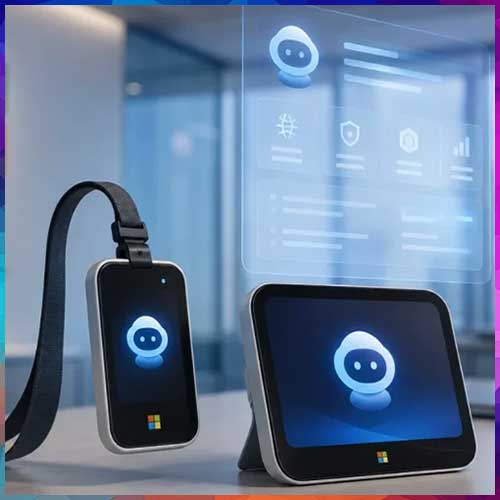
One concept takes the form of a wearable badge equipped with a touchscreen, camera, microphones, speaker, 5G connectivity, and biometric authentication. The device is designed to provide immediate access to AI assistants for functions such as meeting support, scheduling, and workplace productivity tasks.
The second device is a desktop companion featuring a display, microphones, speakers, facial authentication, and integration with Microsoft 365 services. It is designed to surface priority information and provide direct access to AI-powered assistance.
Microsoft has partnered with Qualcomm and MediaTek as the initial silicon providers for Project Solara. The company has also begun internal testing and plans pilot deployments with organisations including AccuWeather, Best Buy, CVS Health, Levi's, and Target in the coming months.