

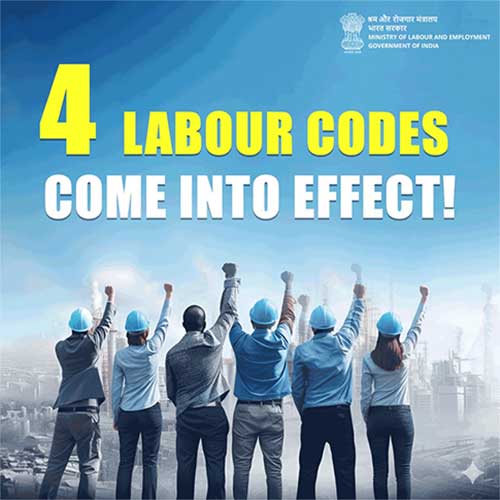
The Government’s decision to notify key provisions of the four Labour Codes, effective 21 November 2025, marks a significant milestone in India’s efforts to modernise its labour governance framework. Enacted between 2019 and 2020, the Codes consolidate 29 central labour laws—many dating back to the 1930s–1950s—into a more contemporary, coherent, and nationally consistent set of regulations better suited to today’s economic realities.
The Gazette notifications outline the specific provisions that have now come into force under each Code, while the remaining sections will be operationalised through future notifications. The accompanying press release clarifies that, during this transition, the corresponding provisions of existing labour Acts and their rules, regulations, and standards will continue to remain in effect.
For businesses, this structured and phased rollout ensures continuity and allows organisations to adapt gradually. Companies can familiarise themselves with the notified provisions, update internal processes, and prepare for upcoming stages of implementation—building on reforms already initiated by several state governments.
From an economic and regulatory standpoint, the Labour Codes aim to expand social security, strengthen workplace safety, and provide clearer norms on wages and employment terms. Key reforms include universal minimum wages, a national floor wage, mandatory annual health check-ups, safeguards for timely wage payments, and enhanced provisions enabling women to work across sectors, including night shifts, with adequate protections. The move toward single registration, single licence, and single return—supported by a National Occupational Safety and Health Board—promises to simplify compliance and improve consistency in enforcement.
For the technology industry, full implementation of the Codes is expected to bring greater predictability and transparency. Provisions related to written appointment letters, fixed-term employment with equal benefits, expanded social security coverage, recognition of gig and platform workers, timely salary payments, equal pay mandates, and structured grievance redressal are especially relevant for a highly skilled, mobile workforce. These measures are poised to enhance workforce mobility, strengthen employee trust, and improve India’s competitiveness as a global hub for technology and digital services.
As the rule-making process progresses, Nasscom will work closely with the Ministry of Labour and Employment and other stakeholders to support a smooth transition. A key focus will be ensuring that central provisions align with state-level requirements—including shops and establishments laws—to prevent duplication, conflicts, or unintended compliance burdens. Nasscom will also advocate for the adoption of technology-driven compliance mechanisms to streamline reporting and improve ease of doing business.
India now has an important opportunity to translate this consolidation of labour laws into a balanced, forward-looking, and implementation-friendly regime. Nasscom remains committed to constructive engagement to ensure that the new labour framework supports workers, enables sustainable business growth, and reinforces India’s position as a global leader in technology and digital innovation.

See What’s Next in Tech With the Fast Forward Newsletter





Tweets From @varindiamag
Nothing to see here - yet
When they Tweet, their Tweets will show up here.