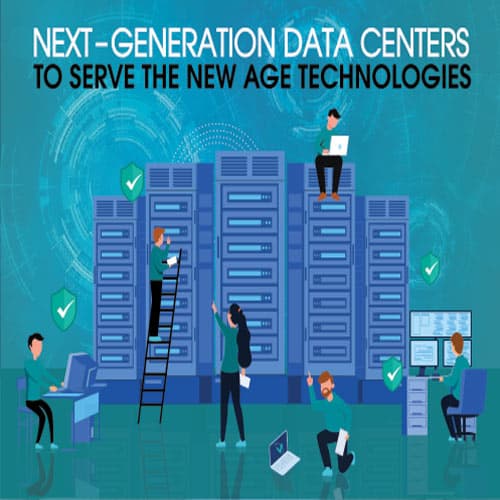
Data centres have played critical roles in stopping the potentially collapsing world’s economy and continues to play an ever-increasing role as the “new normal” takes shape with remote working and a digital financial economy. At the same time, a major factor for the demand for the next-generation data storage market is the increasing cybercrime and data theft associated with cloud and hybrid computing. Hence, there is a need for future ready data centres, which are expected to provide a simpler, more adaptive infrastructure that is capable of responding to change or disruption.
Hybrid Work is one of the effects of the global pandemic. The number of staff allowed on-site was significantly reduced in many countries. The future data centres will fully or partially automate work by adapting AI and Robotic Process Automation solutions. On the other hand, Edge computing will play a huge role in the development of future data centres. Edge computing allows data to be processed closer to the source, reducing latency, leading to the development of mobile data centres, which can easily be situated, eradicating connectivity problems in remote areas.
Data centres need to integrate sustainability into their strategies, as businesses become more and more aware of climate change. Data centres will be expanding and improving their use of data compression, deduplication, and other efficiency-enhancing methods. The role of Data Centers has extended afar, providing enough storage capacity with data security amid the global popularity of cloud computing. Data Centers are now revamped into strategic business assets.
The next generation Data Centers will have layered management tools that can store resources logically as per required workloads. This kind of infrastructure will only be obtained with a sceptic Data Center that lets admin create more powerful and scalable cloud platforms. In future Data Centers, the smooth presentation of resources to the management layer will matter, irrespective of the kind of hardware deployed, enabling clients to flawlessly integrate with outside technologies.
"The focus has been on green data centres"
 Sunil K, Regional Sales Manager, Analog Devices India
According to the International Energy Agency, one percent of all electricity worldwide is used by data centres. It is estimated that they will consume 1/5th of the world's electricity supply by 2025. Hence, the focus has been on green data centres.
Adding an intelligent sensing system to a data centre will reduce the energy consumption in the average data centre where annual consumption can range between hundred kilowatt-hours and thousand kilowatt-hours. ADI's power protection and conversion products provide state-of-the-art architecture and efficiencies that are applicable to data centres of all scales, from edge to hyperscale.
ADI’s end-to-end data center solutions include industry-leading power management solutions for high density servers, storage, and networking systems, optical control solutions for Gigabit connectivity and sensor solutions for data center infrastructure development. The capacity of the data centre industry is expected to double to more than 1,000 MW by 2023 to meet the growing demand amid rapid growth in digitisation.
ESDS creating its own space both as a Data Center and as a Cloud Service Provider
 Piyush Somani, MD & Chairman, ESDS Software
Growth of next-generation data center market
The Central Government released a comprehensive Draft Data Center Policy in November 2020 which focuses on (a) providing infrastructure status to the data center sector, simplifying clearances for setting up data centers in India and Formulation of Data Center Incentivization Scheme for promotion of data center parks, (b) enabling a favourable ecosystem - ensure reliable power, internet connectivity and business continuity, recognize data centers as a separate category under the National Building Code because of the requirement of different norms with respect to other commercial buildings/offices and data centers to be declared as “essential services” (c) setting up of at least 4 data center economic zones in India as a central sector scheme and creating an ecosystem of hyperscale data centers, cloud service providers, IT companies, R&D units and other allied industries and (d) promoting local manufacturing, establishing joint ventures with foreign companies, human resource development by promoting research and capacity building.
A Challenge or Opportunity
As ESDS' Data Center & Cloud division has grown, the R&D team has created several products to complement it. We build Cloud platforms that are secure, flexible, scalable, and reliable, compared with on-premises IT, by combining Cloud infrastructure with well-architected solutions. In ESDS’ journey of 16 years what we have been able to achieve is creating our own space both as a Data Center and as a Cloud Service Provider because of our emphasis on research-based solutions and services. So, as a team, we at ESDS consider this more as a remarkable opportunity than a challenge, because the growth of data centers as an industry is going to be the way forward not just for the industry but for our country both as an economy and a technologically evolving society.
Competition in the data center server CPU innovation market
We believe that the ongoing competition between Intel and AMD may provide a good opportunity as it has accelerated the development of server CPUs, enabling new applications and services opportunities in the data center. It may result into improved CPU performance further translating into increased speed and agility for service providers as well as Data Center customers.
IoT adoption to support next-generation data centers
The automation of business and IT processes through Government SaaS or PaaS initiatives, aimed at digitalization of services have been accentuated by the Covid-19 pandemic, increase in the use of mobile phones, rapid increase in subscription-based cloud services, increase in use of biometric authentication, regulatory enforcement of individual privacy, etc. Cloud industry in India is witnessing a surge in adoption by various industry verticals such as Government sector, manufacturing industry, IT Industry and others. IoT services, big data, and cloud computing are expected to integrate where cloud computing is expected to play the role of a common platform for IoT.
Expectation of High-level consolidation by 2023
India is one of the largest generators of data currently, with a growing young “tech-savvy” population. India’s data consumption is expected to increase at a CAGR of 16% to 25 GB per month by 2025 from 12 GB per month in 2020. India’s plan to have a digital economy would create $ 1 trillion worth of economic opportunities by 2025 thereby helping the cloud industry grow.
Future data centres looking towards catapulting security
 Rajkumar Vijayarangakannan, Technical Evangelist, Manage Engine
Growth of next-generation Data center market
The next generation of data centres has to make room for the exponential growth of data as well as ensure its security and availability by equipping their security systems with intelligent software.
The data centres of the future are looking towards catapulting security to supreme heights by leveraging Zero Trust network access, AI- and ML-based predictive security analytics, and intensive vulnerability scanning and patching. Additionally, containerised and serverless architectures will offer multiple layers of protection by means of network segmentation and application containerisation with enhanced firewalling capabilities. This restricts the lateral movement of hackers throughout the data centre's network as it places security checkpoints across various points in the network, isolating network traffic and restricting access across segments. This promotes improved monitoring and highly secured access control while making it harder for the hacker to breach the data centre's security. All of these coordinated efforts will improve the security posture of the data centre.
A Challenge or Opportunity
ManageEngine envisages that the next generation of data centres will be logically run and managed by software, paving the way for software-defined data centres and promising increased agility, higher productivity, and reduced costs. By deploying predictive analytics, machine learning (ML), and cognitive computing, ManageEngine plans to upgrade its data centre monitoring product lines with AI- and ML-based models along with real-time data analytics; this will tremendously improve data centre performance and energy efficiency.
IoT adoption to support next-generation data centers
The future demands that data centres become environmentally friendly with efficient energy use. IoT-managed data centres help data centre operators to continually monitor servers' energy consumption and to remotely manipulate physical and environmental variables without wasting excess energy, thereby greatly reducing capital and operational costs. This massively decreases the carbon footprint of data centres with less on-site human intervention, bringing forth more sustainable “lights-out data centres.”
Expectation of high-level consolidation by 2023
The emergence of 5G technology means increasing demand for faster connectivity. This will drive data centres to adopt a hybrid model that blends the best attributes of on-premises data centres: colocation and edge computing for enhanced processing power. At the same time, enterprises are moving workloads to public cloud operators to address scaling demand. So, at one end of the spectrum there is consolidation happening, but the other side is still seeing efforts made to optimise costs.
5G, AI, IoT and other technologies fuelling demand for next-generation data centers
 Haresh Lalchandani, Head - Custom & Edge DC Build, Yotta Infrastructure
Growth of next-generation Data center market
In today’s digital world, the widespread adoption of 5G, Artificial Intelligence, Internet of Things, Big Data and Analytics and other technologies, is driving an exponential shift towards third party colocation, cloud, and usage-based IT services – all of which are fuelling demand for next generation of data centers. In addition, the widened scope of digital transformation with the proliferation of emerging technologies is resulting in a massive surge in data generation.
Another factor that will contribute to this growth is the government’s announcement granting data centers infrastructure status in this year’s Union Budget. It also announced several progressive steps to take the Digital India vision to new heights – from building digital universities and pushing for digital payments to integrating post offices with core banking systems and launching the Digital Rupee using blockchain. All these initiatives come together and dovetail with our focus on expanding our hyperscale data center footprint, complemented by Edge data centers for last-mile access.
A Challenge or Opportunity
Yotta is highly bullish on the Digital India growth story and sees it as a massive opportunity. The granting of infrastructure status in 2022 Budget announcement has provided impetus to bolster our contribution to the Digital India mission. In line with this vision, our Navi Mumbai campus already has the core and shell ready for a second data center called NM2. We also have the space to develop three more data center facilities on this very campus.
Yotta NM1 data center is a testimony to our efforts. We combine our world-class infrastructure with unmatched, always-on services guaranteed by SLA commitments and support. This further helps us gain a competitive edge and tap a larger share of opportunities.
IoT adoption to support next-generation data centers
As internet exchanges like DE-CIX India increasingly establish points-of-presence with data center players like Yotta, enhanced network performance, low latency, one-hop hyperscale cloud connectivity, and domestic and international internet peering services will become the norm. Such partnerships tie-in with low-latency edge requirements ensuring seamless, last-mile content delivery through a vast footprint of network nodes across the country. Interconnection and peering services, Edge data centers and IoT will soon combine to drive the next leg of data center growth.
Yotta is coming up with hyperscale data center parks and Edge data centers in strategic locations across India. Over the next year we aim to expand by going live with our data center projects in Maharashtra, Gujarat, Tamil Nadu, West Bengal and Delhi-NCR. These projects will deliver a capacity of 1030 MW by providing cloud, networking, and other ICT infrastructure. Coming to Edge data centers, the aim is to set up at least 100 such facilities across India with an investment of Rs. 900 crores over the next few years.
Expectation of high-level consolidation by 2023
We are currently witnessing another inflection point, driven by the pandemic, which has resulted in the growth of data-driven cloud services and OTT, fuelling data center demand. Although 2023 appears too soon for consolidation, the data center market requires significant investments and commitment. Eventually, the smaller players who forayed into the space will not see value, which might lead to a spate of mergers and acquisitions.
High-quality, reliable, scalable services and infrastructure to drive Data Center growth
 Vimal Kaw, Head, Data Center Services, NTT
Growth of next-generation Data center market
With holistic and across-the-spectrum digital transformation taking place, the multi-tenant data centers are witnessing accelerated growth. The prevailing circumstances have underlined two key change areas that will dominate the future of the data center business.
1. Rise of smart colocation data centers
2. Switch from the convention of lock-ins to pay-as-you-go model
The data center industry will now see the service providers increasingly expand their portfolios to offer end-to-end ‘as-a-service’ solutions spread across infrastructure, networking, digital productivity enhancement, cloud, data recovery and cybersecurity arenas. High-quality, reliable, and scalable services as well as infrastructure will drive this growth.
A Challenge or Opportunity
This is definitely an opportunity for us, and we are well prepared to cater to the entire spectrum of digital services for our clients all over the world. We are rapidly building new infrastructure with a focus on existing and emerging needs, environmental sustainability, and democratization of digital access in the new normal. We are excited about the next generation of data centers that we are helping evolve.
Competition in the Data center server CPU innovation market
Digitization and evolution of 5G, multi-cloud ecosystems, and the rising importance of network edge among the enterprise customers globally, is creating an exponential surge in demand for chip advancements. It is good to see Intel and AMD race towards creation of innovative, next-generation CPU technologies. We believe that this competition between these two companies, and other chip makers, augurs well for the technology sector, as it will constantly push towards performance enhancement, and diversity.
IoT adoption to support next-generation data centers
IoT is going to play a great role in the growth of next-generation DCs due to its ability to monitor, and automate operations. The AI/IoT technologies are capable of helping DCs achieve superior resource optimization, lower power consumption, automation, and security etc.
Expectation of high-level consolidation by 2023
Consolidation and restructuring are part of the evolution in technology sector. By consolidating our different businesses under one umbrella, we have gained a decisive edge over our competitors in several markets, and we foresee such consolidation, M&As, take place in 2023 as well.
Next-generation data centers help in fast-changing corporate and technology landscape
 Sanjay Virnave, General Manager And Country Head, Altos Computing India
Growth of next-generation Data center market
According to the Mordor Intelligence report, The Indian data center market is expected to grow at a CAGR of 8% over the forecast period 2021 to 2026. The instant adoption of cloud-based business operations has helped businesses to obtain data management capacities to manage huge amounts of data that are being created.
The growing business needs for advanced processor technologies, complex data evaluation, and high storage demands are accrediting to the development of next-generation data center infrastructures. Today’s businesses require extremely consistent products, more servers in the data center, and secondary data centers to persist exist in the aggressive and responsive environment. Next-generation data centers help the increasing requirement for a very reliable fast-changing corporate and technology landscape. Also, these data centers meet the growing expectations for high speed, scalability, and availability.
Competition in the Data center server CPU innovation market
Industry is moving towards data center solutions which are consumption based and pay per use. The front runners of Cloud providers have been successfully offering this over cloud for years. While historically Intel has been the leader in data center server CPU’s, is now facing competition from AMD. We also have a few more players emerging strong in this space.
This stiff competition brings in innovation around speed agility and new feature launches. Intel with its Ice Lake Xeon Scalable CPU’s and AMD with its EPYC processors are competing with each other in this space. With this new use cases are coming up and benefitting the cloud service providers and end customers.
Intel recently announced ultra-efficient CPU family code named Sierra Forest developing a new, broad-based data centre architecture strategy, for continuing development and leadership in the data centre industry. The growth will be fuelled by these new next-generation cloud, network, and edge solutions. Meanwhile Nvidia which was a GPU provider has jumped into this with Arm-based data center CPU for AI and high-performance computing and claims will provide 10 times faster AI performance. The new data center CPU, named Grace, creates new competition for CPU rivals Intel and AMD when it arrives in early 2023.
IoT adoption to support next-generation Data centers
The Internet of Things has seen the globe turn into another era of advancement, as people and organizations embrace the growth it brings. IoT devices are everywhere and will play a major role in the future to assist enterprises or individuals to engage in communication more easily and effectively. That’s also what Acer is focusing on at the moment. Through Artificial Intelligence and the Internet of Things, Acer is determined to offer a smarter efficient, and convenient lifestyle for people.
5g is also the growth we will see in the year 2022- 23. The power, bandwidth, and speed of 5G products will transform how businesses work. The industry will also become more resilient and competitive. This will increase the demand for 5G products and encourage us to bring more options, innovations, and opportunities to the industry. The government’s announcement on 5G auction and facilitate private players to roll out services before March 2023 is a push to enable growth and job opportunities. The focus on 5G technology will help in data speeds, reliability, increased network capacity & uniform user experience. The lower latency and higher bandwidths will benefit multiple sectors and especially the consumer technology, content consumption, gaming, segment to name a few. 5G is also a great push for the gaming industry, it facilitates innovative gaming products with real-time capabilities, when blended with AR and VR it enhances the experience.
Expectation of high-level consolidation by 2023
Consolidation is a little distance away as a lot of innovation is expected around performance per watt, segment features and cutting-edge competitiveness. Intel’s road map up to 2024 talks of bringing two optimized platforms Performance-Core and Efficient Core into one single industry defining platform. Similarly, AMD is to launch a next gen EPYC server CPU that features up to 96 cores. AMD plans to ramp us the count to 128 with new slate of EPYC CPU’s in 2023 that would be tailored for cloud customers. Nvidia is also making moves with its ARM based grace CPU targeting HPC customers, slated to be launched in 2023. Hence, the competition is heating up and the chip makers are evolving new products to tackle Power consumption, Cooling, efficiency, software management etc. which would be the key to the growth to the next level.
“Organizations must turn to modernized systems to support diverse workloads”

Data and monetization of data has become the key driver for digital transformation, and we know that the amount and sources of data have increased manifold. Organizations need to access, store and secure their customer data regularly, improve their data efficiency, and extract the maximum value from; what we call the data-first mindset.
As predicted by Gartner, 75% of enterprise data will be processed outside of a traditional, centralized data center or cloud by 2025. Hence, to achieve faster insights and deliver a connected experience to customers, organizations must turn to modernized systems that can seamlessly shift resources to support diverse workloads across on- and off-premises eco-systems.
Servers are the underlying technology that delivers the highest performance capabilities for a business entity. With the uptake in the adoption of technologies like cloud computing, virtualization, and big data, businesses need to deploy advanced servers that form the foundation of modern age IT architecture, running multi-workloads from the edge to core the cloud. Dell EMC PowerEdge servers can help establish the right hybrid infrastructure for an organization, providing them with the choice and the control for optimal management of critical workloads.
As an industry visionary, we understand the evolving needs of our customers. With Dell EMC PowerEdge in our server portfolio, we are drawing the path toward autonomous infrastructure to offer greater IT efficiency, enable our customers to embrace AI, and address the demands of IT at the edge. Our offerings cut across a broad range of customer requirements, from SMBs to large enterprises, addressing the varied and complex needs of the modern data center.