
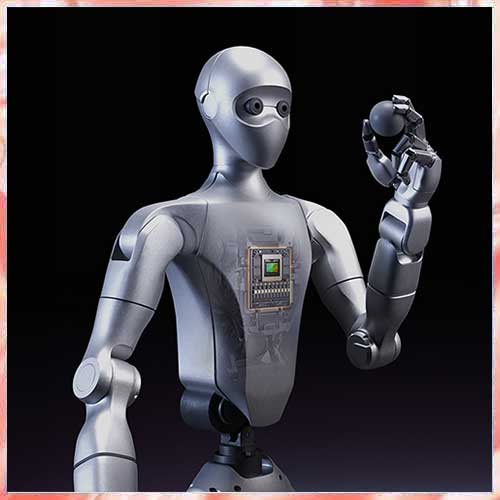
The new research platform combines Nvidia’s AI computing and software stack with Unitree’s humanoid robot, aiming to accelerate robotics development and make advanced humanoid systems more accessible to universities and research institutions.
Nvidia has unveiled a new humanoid robotics platform designed for academic and research institutions, marking a significant step in its push into the emerging field of physical AI. The system integrates a humanoid robot developed by Chinese robotics company Unitree with Nvidia’s latest AI hardware and software technologies, creating a ready-to-use platform for robotics research and development.
The offering combines Unitree’s H2 humanoid robot with Nvidia’s Jetson Thor computing platform, which is powered by the company’s Blackwell GPU architecture and is designed to support advanced on-device artificial intelligence workloads. Nvidia said the platform also incorporates its Isaac GR00T family of humanoid AI models and simulation tools, enabling researchers to develop, train and test robotic applications in both virtual and real-world environments.
Speaking during a keynote presentation in Taipei, Nvidia Chief Executive Officer Jensen Huang described the system as a fully integrated humanoid robotics platform built to simplify access to advanced robotics technology. He said the solution combines hardware, simulation, data generation and runtime software into a single package intended for broad use by the research community.
Expanding access to humanoid robotics research
According to Nvidia, the platform has been developed specifically for universities and research organisations, where building a comparable system from scratch would require significant technical expertise and resources. The robot features advanced dexterity through mechanical hands supplied by Singapore-based Sharpa, complementing the broader AI and simulation capabilities included in the package.
Several leading research institutions have already committed to using the platform, including the Stanford Robotics Center, ETH Zurich, Seattle-based Ai2 and the Advanced Robotics and Controls Laboratory at the University of California San Diego. Nvidia believes providing a standardised research platform could help accelerate innovation and lower barriers to entry in humanoid robotics development.
Unitree expands global ambitions
The announcement comes as Unitree seeks to strengthen its international presence. The company has disclosed that more than 40% of its revenue is generated outside China and is pursuing a public listing on Shanghai’s STAR Market to support future growth.
Unitree is also preparing to launch the H2 Plus, an upgraded version of its humanoid robot, in October. Nvidia executives indicated that the new model will be commercially available, broadening access beyond research institutions.
While interest in humanoid robotics continues to grow, the sector remains in its early stages. Most deployments of AI-powered humanoids are currently concentrated in industrial and warehouse environments, with concerns around safety, privacy and reliability still limiting broader adoption in homes and everyday settings. Nevertheless, Nvidia sees robotics as a major long-term opportunity and expects the market to expand significantly in the coming years.