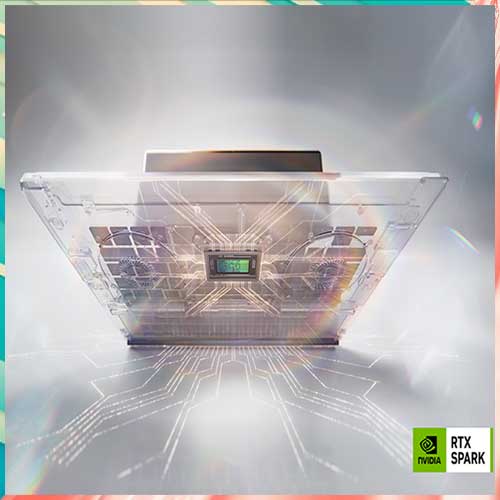
NVIDIA has launched RTX Spark, a new AI-focused superchip designed to transform Windows PCs into platforms capable of running personal AI agents locally, marking one of the company's most ambitious efforts yet to redefine the role of the personal computer in the AI era.
Announced by NVIDIA CEO Jensen Huang, RTX Spark combines an NVIDIA Blackwell RTX GPU with a 20-core Grace CPU connected through the company's NVLink-C2C interconnect technology. The platform is designed to power AI agents, content creation workloads and gaming on a new class of Windows devices ranging from ultrathin laptops to compact desktops.
"The PC is being reinvented," Huang said, arguing that users will increasingly move away from launching applications manually and instead rely on AI agents to complete tasks on their behalf.
The announcement highlights NVIDIA's strategy to extend its dominance beyond AI data centers and into personal computing, where the next battleground is emerging around on-device AI. Rather than sending every AI request to the cloud, RTX Spark is designed to run sophisticated AI models locally, allowing users to deploy personal assistants capable of working across applications, files and workflows while keeping sensitive data on the device.
NVIDIA said RTX Spark delivers up to one petaflop of AI performance and includes up to 128GB of unified memory, enabling users to run large AI models, multimodal applications and autonomous agents directly on their PCs.
A key element of the initiative is NVIDIA's partnership with Microsoft. The companies are introducing new Windows security capabilities alongside NVIDIA's OpenShell runtime to allow AI agents to operate under user-defined policies and privacy controls. The system is designed to let users determine what agents can access, what tasks they can perform and when information can be shared with cloud-based AI models.
The companies are positioning the platform as a secure foundation for the next generation of agentic AI applications. Early support is coming from projects including OpenClaw and Nous Research's Hermes Agent, which plan to build Windows applications capable of carrying out complex tasks across multiple applications and workflows.
Beyond AI, NVIDIA is also targeting creators and gamers. RTX Spark systems will support rendering large 3D scenes, running large language models with up to 120 billion parameters, editing high-resolution video, and playing modern games with ray tracing and DLSS technologies.
The company said more than 100 software and gaming companies, including Adobe, Blackmagic Design, Blender, CapCut, NetEase Games and Xbox, are supporting the platform. NVIDIA is also working with Adobe to optimize Photoshop, Premiere Pro and other creative applications for RTX Spark-powered systems.
Major PC manufacturers including Dell Technologies, HP Inc., Lenovo, ASUS, MSI and Microsoft's Surface division are expected to launch RTX Spark-based devices.
For enterprises, the significance of RTX Spark extends beyond hardware. It signals NVIDIA's vision of a future where AI agents become a core computing interface, moving AI workloads from centralized cloud environments to end-user devices. If successful, the platform could help create a new category of AI-native PCs capable of running personal assistants, enterprise copilots and autonomous workflows locally while reducing dependence on cloud infrastructure.
Announced by NVIDIA CEO Jensen Huang, RTX Spark combines an NVIDIA Blackwell RTX GPU with a 20-core Grace CPU connected through the company's NVLink-C2C interconnect technology. The platform is designed to power AI agents, content creation workloads and gaming on a new class of Windows devices ranging from ultrathin laptops to compact desktops.
"The PC is being reinvented," Huang said, arguing that users will increasingly move away from launching applications manually and instead rely on AI agents to complete tasks on their behalf.
The announcement highlights NVIDIA's strategy to extend its dominance beyond AI data centers and into personal computing, where the next battleground is emerging around on-device AI. Rather than sending every AI request to the cloud, RTX Spark is designed to run sophisticated AI models locally, allowing users to deploy personal assistants capable of working across applications, files and workflows while keeping sensitive data on the device.
NVIDIA said RTX Spark delivers up to one petaflop of AI performance and includes up to 128GB of unified memory, enabling users to run large AI models, multimodal applications and autonomous agents directly on their PCs.
A key element of the initiative is NVIDIA's partnership with Microsoft. The companies are introducing new Windows security capabilities alongside NVIDIA's OpenShell runtime to allow AI agents to operate under user-defined policies and privacy controls. The system is designed to let users determine what agents can access, what tasks they can perform and when information can be shared with cloud-based AI models.
The companies are positioning the platform as a secure foundation for the next generation of agentic AI applications. Early support is coming from projects including OpenClaw and Nous Research's Hermes Agent, which plan to build Windows applications capable of carrying out complex tasks across multiple applications and workflows.
Beyond AI, NVIDIA is also targeting creators and gamers. RTX Spark systems will support rendering large 3D scenes, running large language models with up to 120 billion parameters, editing high-resolution video, and playing modern games with ray tracing and DLSS technologies.
The company said more than 100 software and gaming companies, including Adobe, Blackmagic Design, Blender, CapCut, NetEase Games and Xbox, are supporting the platform. NVIDIA is also working with Adobe to optimize Photoshop, Premiere Pro and other creative applications for RTX Spark-powered systems.
Major PC manufacturers including Dell Technologies, HP Inc., Lenovo, ASUS, MSI and Microsoft's Surface division are expected to launch RTX Spark-based devices.
For enterprises, the significance of RTX Spark extends beyond hardware. It signals NVIDIA's vision of a future where AI agents become a core computing interface, moving AI workloads from centralized cloud environments to end-user devices. If successful, the platform could help create a new category of AI-native PCs capable of running personal assistants, enterprise copilots and autonomous workflows locally while reducing dependence on cloud infrastructure.