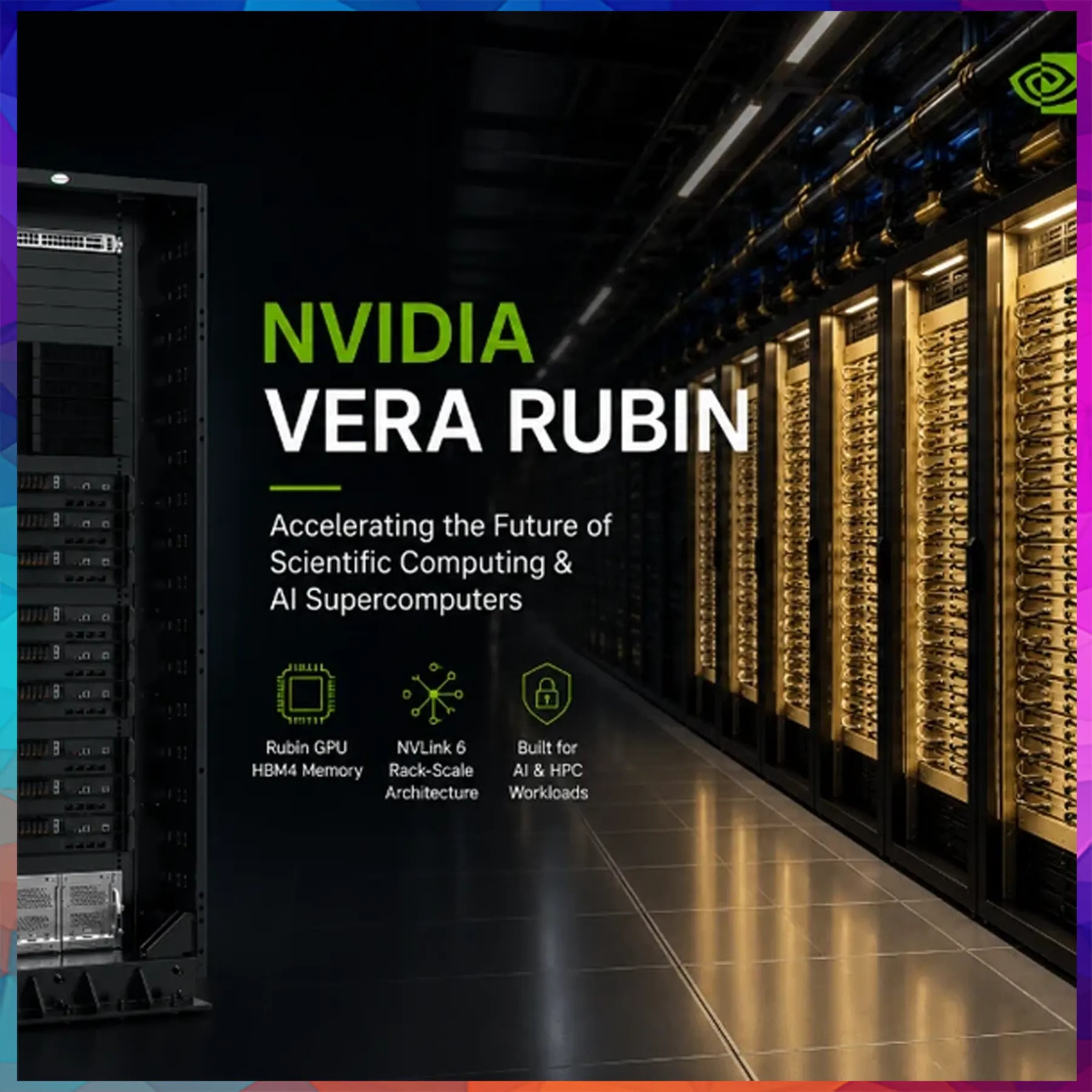
NVIDIA is redefining artificial intelligence infrastructure with its revolutionary Vera Rubin NVL72 supercomputer, featuring a cable-free modular architecture and 100% liquid-cooled rack design. The innovation represents a significant leap towards faster, more efficient and reliable AI computing.
Unlike conventional server systems requiring extensive manual cabling, Vera Rubin uses modular compute trays with integrated connections. Each Vera Rubin Superchip combines one Vera CPU with two Rubin GPUs, while the complete NVL72 rack integrates 36 CPUs and 72 GPUs.
The most remarkable innovation is deployment simplicity. NVIDIA's latest demonstration highlights assembly taking approximately five minutes, compared with around two hours for earlier Grace Blackwell configurations. This dramatically reduces installation complexity, maintenance effort and potential human errors.
Its fully liquid-cooled architecture addresses one of AI infrastructure's biggest challenges: excessive heat generation. Efficient heat removal helps maintain stable performance during demanding workloads while potentially reducing cooling-related electricity consumption and operating costs.
Reliability is another major advantage. NVIDIA integrates real-time system health monitoring, fault-tolerance mechanisms, proactive maintenance and modular servicing. These capabilities can minimise downtime, simplify component replacement and improve operational continuity across large AI data centres.
However, cable-free does not mean completely wireless. The system still requires electrical power, networking and internal interconnections. Similarly, liquid cooling demands dependable pumps, coolant distribution, leak detection and monitoring. Actual reliability depends on deployment quality and sustained operational performance.
NVIDIA's larger ambition extends beyond building faster GPUs. By integrating computing, networking, cooling and software into one AI infrastructure platform, the company is accelerating the transition towards industrial-scale AI factories. Vera Rubin demonstrates how innovation in system engineering could make autonomous AI, advanced research and enterprise computing more scalable, energy-efficient and economically sustainable.