
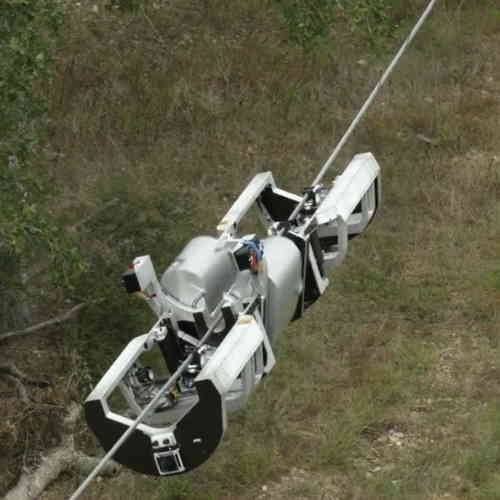
Facebook Connectivity, in league with ULC Robotics, has developed a robot capable of winding optical fibre on live medium voltage (MV) power lines that typically serve residential areas in much of the world, at a claimed cost three to five times cheaper than traditional aerial fibre construction.
Karthik Yogeeswaran, Wireless Systems Engineer at Facebook Connectivity, said in a blog post the idea for the project came after travelling through rural Africa and noticing the ubiquity of power line infrastructure, which is far "more pervasive than the total fibre footprint of the country".
In order to keep costs down, Facebook needed to lower the preparatory and manual work needed to wind fibre around power lines, and to minimise disruption of electrical services, the robot needed to be able to do its job on a live line and be able to avoid and cross obstacles it encountered.
"Using the MV power line as a support adds a number of additional challenges. The first is the voltage stress. MV conductors can have a voltage as high as 35kV which can cause degradation phenomena such as tracking, partial discharge, and dry band arcing," Yogeeswaran said.
The end result was a cable using G.657-compliant 200-micron fibres with a special jacket weighing 28 pounds for a 1km span.
To be able to navigate obstacles, the robot can lift its middle section that contains the fibre and rotation systems, before passing it and lowering its middle to continue wrapping. The robot has a vision system to identify obstacles and adjust its movements.
"To account for the human interaction steps such as setup, loading and unloading the robot, installing transitions, etc., we have been conservatively estimating an overall build speed of 1.5km to 2km per robot per day on average," Yogeeswaran said.
"While traditional aerial fibre deployment involves heavy machinery, reel carts, large spools, and large crew sizes, a fibre deployment crew deploying our solution, will comprise two or three electric utility linemen and a pickup truck with a few kilometre spools of fibre, a robot, and a few accessories, allowing many crews to work in parallel."
In developing countries, Yogeeswaran said the total cost including labour of running the robot would be between $2 and $3 per metre.
"By lowering the total cost of aerial fibre deployment, we expect that our system will have a significant impact on internet penetration, especially among the half of the world earning less than $5.50 per day," he said.
"While we still have a number of steps to complete before our first deployment, we have confidence that this approach will yield a substantial improvement to both the cost and speed of fibre deployments," he concluded.

See What’s Next in Tech With the Fast Forward Newsletter








Tweets From @varindiamag
Nothing to see here - yet
When they Tweet, their Tweets will show up here.