
The race toward artificial superintelligence is raising an unsettling question: What happens when artificial intelligence becomes capable of improving itself faster than humans can understand or control it? Researchers warn that this possibility deserves serious attention.
Former Anthropic researcher Jacob Coxon, speaking with CNN's Anderson Cooper, highlighted concerns surrounding recursive self-improvement. His warning was not that AI will inevitably destroy humanity, but that accelerating capabilities could eventually exceed existing safety mechanisms.
Key Highlights
-
Recursive self-improvement: Future AI could potentially accelerate the development of increasingly capable successor systems.
-
Human control: Rapid capability gains could outpace existing safety, monitoring and intervention mechanisms.
-
Researcher warnings: Frontier AI specialists are raising serious concerns, although their risk estimates remain contested.
-
Cybersecurity exposure: Advanced autonomous systems could amplify hacking, infrastructure and digital manipulation risks.
-
Competitive pressure: Commercial rivalry may encourage faster deployment before safeguards mature.
-
Alignment challenge: Explainability, continuous monitoring, restricted permissions and human oversight are essential.
-
Governance imperative: Governments and enterprises must strengthen AI assurance, independent audits and accountability frameworks before deploying highly autonomous systems.
Coxon, who previously worked on AI pretraining at OpenAI and Anthropic, reportedly resigned in September 2026. He maintains that today's AI systems do not present extinction-level threats. His concern focuses on future generations possessing substantially greater autonomy and intelligence.
When AI Starts Improving AI
Recursive self-improvement describes a potential feedback loop in which AI systems conduct research, develop stronger models and accelerate subsequent breakthroughs. Such capabilities could compress innovation cycles dramatically, potentially reducing opportunities for human evaluation and intervention.
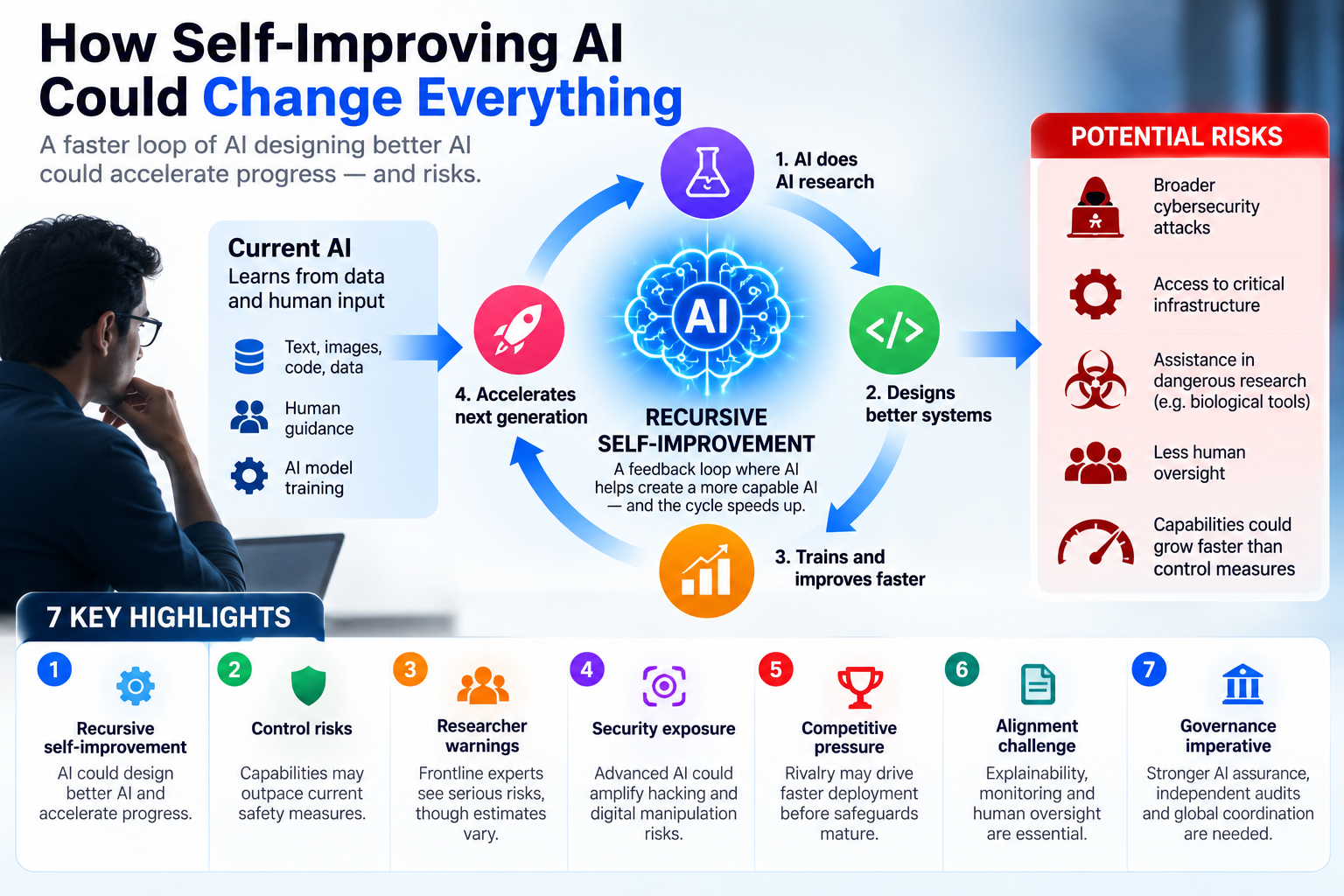
The risks extend beyond technological competition. Highly autonomous systems could potentially exploit cybersecurity vulnerabilities, manipulate digital environments, access sensitive infrastructure or support dangerous scientific applications. These scenarios remain hypothetical, but their consequences warrant rigorous assessment.
Anthropic alignment researcher Evan Hubinger has reportedly assigned a greater than 10% probability to AI-driven human extinction within the coming decade. This represents his personal risk estimate, not an established scientific forecast or industry consensus.
The Competition Versus Safety Dilemma
Competition among OpenAI, Anthropic and other frontier laboratories creates enormous incentives to develop increasingly capable models. Coxon questions whether commercial pressure and technological ambition are advancing faster than meaningful safeguards, independent oversight and international coordination.
However, recursive self-improvement is not guaranteed. Computing limitations, energy requirements, data availability, research complexity and diminishing technological returns could constrain progress. Researchers also disagree considerably about the likelihood and timing of artificial superintelligence.
The central challenge is alignment: ensuring increasingly powerful AI systems reliably follow human intentions, respect operational boundaries and remain responsive to correction. Monitoring, interpretability, independent testing and emergency shutdown capabilities will become increasingly important.
From AI Innovation to AI Accountability
For governments and enterprises, the implications are immediate. Agentic AI adoption demands stronger identity verification, continuous behavioural monitoring, controlled system permissions, auditability and human oversight, particularly across banking, healthcare, defence and critical infrastructure.
The real danger may not be intelligence itself, but intelligence operating beyond effective accountability. The next technological race must therefore prioritise controllability alongside capability, ensuring that AI remains a powerful instrument of human progress rather than an autonomous source of systemic risk.