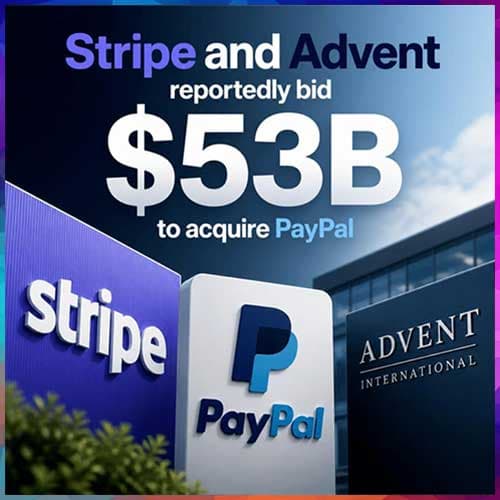
The global payments industry could be on the verge of its biggest transformation in years. Stripe, in partnership with private equity firm Advent International, has submitted a $53 billion acquisition proposal for PayPal, offering $60.50 per share—a premium of approximately 28% over PayPal's recent market price. The proposal is backed by nearly $50 billion in committed financing, while Stripe, Advent, and Block are contributing $17 billion in equity. If approved, the deal would keep PayPal intact under joint ownership rather than splitting up its businesses.
The timing reflects PayPal's changing market position. Once valued at nearly $360 billion, the payments pioneer has struggled against growing competition from Apple Pay, Google Pay, and emerging fintech platforms. Although PayPal continues to generate healthy revenues and payment volumes, investors remain concerned about its long-term growth trajectory. The company has responded with aggressive cost-cutting, AI-led operational transformation, and workforce restructuring to improve profitability.
For Stripe, the acquisition is about strategic expansion rather than rescuing a declining business. Stripe dominates merchant payment infrastructure but lacks PayPal's vast consumer ecosystem of hundreds of millions of active users. Combining Stripe's developer-first payment technology with PayPal's global consumer network would create one of the world's largest integrated digital payment platforms.
The proposed acquisition also aligns with the industry's growing focus on stablecoins and blockchain-enabled payments. Both Stripe and PayPal have expanded their digital asset strategies, while Visa, Mastercard, and BlackRock are also investing heavily in tokenized payment infrastructure. A combined entity could significantly accelerate the adoption of stablecoin-based transactions across mainstream commerce.
The structure of the offer is equally significant. Rather than dismantling PayPal, Stripe and Advent intend to preserve its brand, customer relationships, and merchant network. This suggests confidence in PayPal's long-term strategic value despite recent market challenges.
The biggest uncertainty now lies with regulators. A merger between two global payment leaders would likely attract intense antitrust scrutiny across multiple jurisdictions, given its potential impact on competition, digital payments, and financial infrastructure.
If completed, the transaction would reshape the competitive landscape of global payments. It would combine consumer payments, merchant services, AI-driven financial operations, and blockchain innovation into a single platform—creating a formidable competitor in the next generation of digital finance.