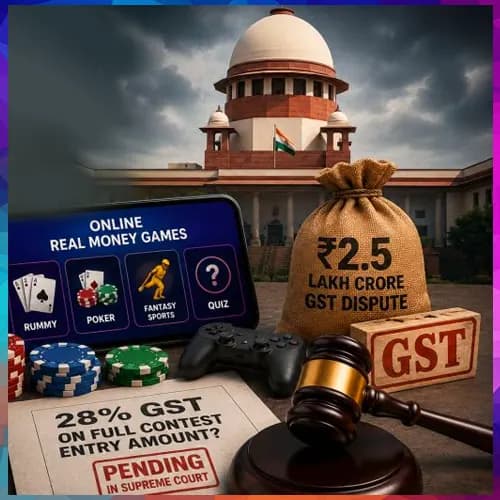
The apex court has confirmed that online gaming platforms fall under GST liability at 28 per cent and upheld state laws restricting stake-based games, marking a major regulatory shift for India’s real-money gaming industry.
In a significant blow to India’s online gaming industry, the Supreme Court has upheld the retrospective imposition of 28 per cent Goods and Services Tax (GST) on online gaming platforms. The court also ruled that companies offering real-money games are not merely intermediaries but suppliers of actionable claims, making them liable for taxation.
A bench comprising Justices JB Pardiwala and R Mahadevan delivered the verdict while also affirming the validity of state laws in Tamil Nadu and Karnataka that criminalise online games played for stakes, including rummy, poker and fantasy sports. The court overturned a Karnataka High Court decision that had earlier ruled in favour of gaming companies.
The Supreme Court clarified that while the levy of GST on actionable claims related to betting and gambling is constitutionally valid, the final determination of tax liability in individual cases will be made by relevant GST authorities. It further observed that online gaming platforms cannot avoid tax obligations by positioning themselves as mere technology facilitators.
Long-running tax dispute reaches decisive stage
The case originates from multiple GST notices issued to real-money gaming companies. Authorities argued that tax should be calculated on the full face value of bets or entry amounts, rather than only on the commission or platform fee earned by operators. Gaming companies, however, had contended that GST should apply only to their net revenue after payouts to winners.
The issue escalated following the GST Council’s 2023 decision to impose 28 per cent GST on the entire value of online gaming, casinos and horse racing activities. Subsequent enforcement actions resulted in tax demands estimated at around ₹1.12 lakh crore, with total liabilities including penalties and interest potentially reaching ₹2.5 lakh crore for the industry.
Industry impact and legal implications
Legal experts believe the ruling could significantly reshape India’s digital gaming landscape. Many companies have already either shut down operations or revised their business models in response to tightening regulatory oversight on real-money gaming.
Experts also suggest that the Centre may consider invoking Section 11A of the CGST Act to regularise past tax practices followed before September 2023, when lower GST rates were commonly applied across the sector.
The court further observed that betting and gambling fall under the category of “res extra commercium”, meaning activities outside the scope of protected trade and commerce rights, and therefore cannot claim fundamental constitutional protection.
Industry stakeholders have described the judgment as a major setback for skill-based gaming platforms, arguing that it blurs established legal distinctions between games of skill and chance. Legal analysts also note that the ruling strengthens the authority of states to regulate or prohibit stake-based online games, adding fresh uncertainty for India’s rapidly evolving digital gaming ecosystem.