The rise of generative AI platforms such as ChatGPT and Google Gemini is fundamentally reshaping how people discover information online. For more than two decades, Google Search has been the gateway to the internet, generating billions of daily queries and serving as the backbone of Google's advertising empire. However, the emergence of AI assistants capable of delivering direct answers instead of lists of links is beginning to change user behavior and challenge the traditional search model.
Consumers increasingly prefer conversational AI because it saves time. Instead of opening multiple websites, users can ask a complex question and receive a summarized response in seconds. This shift has already started affecting traffic patterns across websites, publishers, and search engines. While Google continues to dominate global search, the company recognizes that the future lies in combining search with AI-powered experiences.
Rather than replacing Search, Google is likely to evolve it into a two-tier ecosystem. Traditional Google Search will remain the default, free-to-use platform for billions of users worldwide. It will continue to serve advertisements, collect search intent data, and provide access to the broader web ecosystem. Search data remains Google's most valuable asset, powering advertising, personalization, and AI model improvements.
At the same time, Gemini is expected to become Google's premium intelligence layer. Advanced AI capabilities—including deep research, autonomous agents, coding assistance, content generation, and enterprise productivity tools—are increasingly moving toward subscription-based models. This mirrors the strategy adopted by OpenAI, Microsoft, and other AI leaders. As AI computing costs remain high, premium users will likely fund the most advanced Gemini experiences.
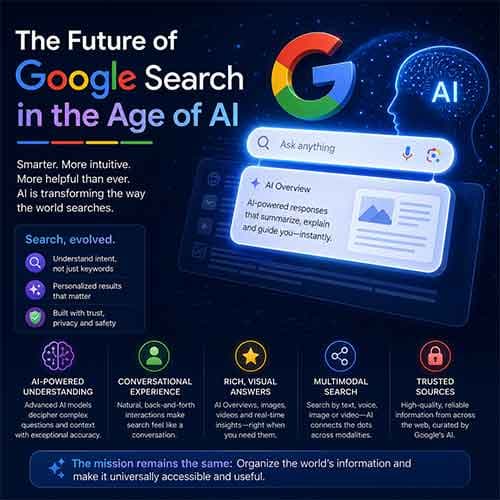
The long-term future may see Google Search evolve into an "AI-first search engine" where traditional search results coexist with AI-generated answers. Search will remain essential for real-time information, commerce, navigation, and content discovery, while Gemini will act as a digital assistant capable of reasoning, planning, and completing tasks. In effect, Google may operate two complementary engines: Search for discovering information and Gemini for understanding and acting on it.
Evolution of Information Discovery
2000–2020
Traditional Search Era
Google Search Dominates
        │
        â–¼
2023–2025
AI Assistant Era
ChatGPT • Gemini • Copilot
        │
        â–¼
2026–2030
Hybrid Search + AI
Search + Conversational Answers
        │
        â–¼
2030+
Agentic AI Era
AI Plans, Researches & Executes Tasks
        │
        â–¼
Future
Search = Information Discovery
AI = Decision Making & Action
The real question is not whether AI will replace Google Search. The more likely scenario is that Google will transform Search into the world's largest AI-powered information platform while positioning Gemini as its premium intelligence engine. The winners of the next decade will be companies that can successfully combine information retrieval, AI reasoning, user trust, and sustainable business models into a unified digital experience.