
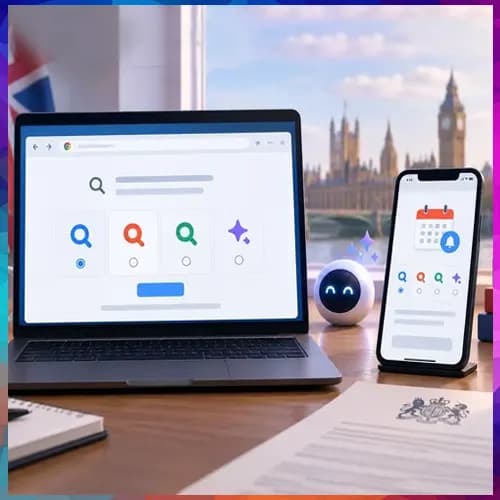
Britain's competition watchdog wants Google's dominant platforms to offer users a genuine choice of search engines and AI assistants, with annual reminders and clearer credit for publishers whose content appears in results.
The UK's Competition and Markets Authority (CMA) has put forward new measures aimed at loosening Google's grip on search, focusing on Android smartphones and the Chrome browser, where the company's control is strongest. The proposals build on recommendations the regulator made earlier this year.
The first proposal would require Google and Android handset makers to present buyers with a choice of search providers when they first set up a device or launch Chrome. Users would then be prompted again every year.
The second would extend choice to AI assistants, provided those services meet defined technical and security standards. The third would oblige all search providers to credit publisher content clearly when it appears in results, making original sources easy to identify and visit.
British users can already pick a search provider on both Android and Chrome, so parts of the plan may simply formalise existing practice. The annual prompt, however, would be new.
Regulator's rationale
CMA chief executive Sarah Cardell said the way people look for information is changing as new services create openings for innovation and competition. She noted that the regulator had weighed feedback and was acting quickly because more people now treat AI assistants as search tools, yet those assistants are absent from Google's existing choice screens. The aim, she said, is to future-proof consumer options as new services reach the market.
Building on earlier steps
The latest plan follows a rule introduced on June 3 allowing publishers to opt out of having their content used in AI-generated results. On June 17, the CMA added requirements covering fair ranking in Google search and data portability.
Other jurisdictions, including Europe, already require phone makers to offer a choice of search engine and browser at first use. AI assistants remain a harder case: Google's Gemini is deeply woven into Google Search, leaving users no way to swap it out for now.
Elsewhere in the industry, Apple has reportedly built private hooks into macOS 27 and iOS 27 that would let apps replace the server behind Siri's AI features with third-party models such as Claude. That may signal preparation for upcoming rules on AI assistants.