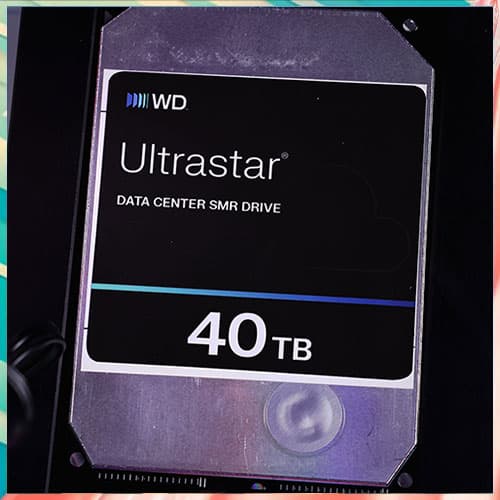
Global hard drive supply is tightening sharply as AI-driven data center demand absorbs nearly all available production capacity for 2026, with leading manufacturers Western Digital and Seagate confirming that their output for next year is already fully — or almost fully — sold out.
The disclosures came from company executives during recent analyst calls, confirming industry speculation dating back to late 2025. Market watchers expect the situation at Toshiba, the world’s third major hard disk drive (HDD) manufacturer, to be similar.
The bulk of committed capacity is being taken up by hyperscalers building out AI data centers, where high-capacity hard drives are used extensively for storing training datasets and inference logs. Customers include Amazon Web Services, Google Cloud, Microsoft Azure, Meta, and OpenAI.
According to SeekingAlpha, Western Digital CEO Tiang Yew Tan said the company is effectively sold out through calendar 2026.
“We have firm purchase orders with our top seven customers,” Tan said, adding that Western Digital has also secured long-term agreements extending into 2027 and 2028.
Similarly, Seagate CEO William Mosley told analysts that the company’s nearline HDD capacity — drives designed primarily for servers and cloud infrastructure — is fully allocated through 2026. Orders for early 2027 are expected to open in the coming months, with discussions already underway for demand into 2028.
Nearline drives now dominate Seagate’s business, accounting for 87% of total HDD sales, up from 83% a year earlier. Despite strong demand, Seagate is not expanding manufacturing capacity, opting instead to drive growth through higher-capacity drives rather than higher unit volumes.
“If we can produce a little more in a quarter, we’ll sell it,” said CFO Gianluca Romano, noting that most output is already committed under long-term contracts.
While Toshiba no longer publishes detailed forecasts after going private in 2023, industry analysts expect its capacity to be similarly constrained.
Rising HDD and SSD Prices Spill Into Retail
The supply crunch is already feeding through to prices. In European retail markets, HDD prices have climbed 20% to 50% since mid-2025. The shortage is also spilling over into solid-state drives (SSDs), as cloud providers increasingly turn to high-capacity SSDs as substitutes.
That shift has pushed manufacturers to reallocate production, driving up consumer SSD prices. Drives with up to 2TB of storage are now around 50% more expensive than last summer, while smaller SSD vendors without in-house memory production — such as Kingston, Lexar and Patriot — have seen prices double or even triple in some cases.
Western Digital’s consumer SSDs are also temporarily disappearing from shelves following its 2025 separation from SanDisk, with products set to relaunch under the SanDisk brand.
With AI infrastructure spending accelerating and no major capacity expansion planned, analysts expect tight HDD supply and elevated storage prices to persist well beyond 2026.
The disclosures came from company executives during recent analyst calls, confirming industry speculation dating back to late 2025. Market watchers expect the situation at Toshiba, the world’s third major hard disk drive (HDD) manufacturer, to be similar.
The bulk of committed capacity is being taken up by hyperscalers building out AI data centers, where high-capacity hard drives are used extensively for storing training datasets and inference logs. Customers include Amazon Web Services, Google Cloud, Microsoft Azure, Meta, and OpenAI.
According to SeekingAlpha, Western Digital CEO Tiang Yew Tan said the company is effectively sold out through calendar 2026.
“We have firm purchase orders with our top seven customers,” Tan said, adding that Western Digital has also secured long-term agreements extending into 2027 and 2028.
Similarly, Seagate CEO William Mosley told analysts that the company’s nearline HDD capacity — drives designed primarily for servers and cloud infrastructure — is fully allocated through 2026. Orders for early 2027 are expected to open in the coming months, with discussions already underway for demand into 2028.
Nearline drives now dominate Seagate’s business, accounting for 87% of total HDD sales, up from 83% a year earlier. Despite strong demand, Seagate is not expanding manufacturing capacity, opting instead to drive growth through higher-capacity drives rather than higher unit volumes.
“If we can produce a little more in a quarter, we’ll sell it,” said CFO Gianluca Romano, noting that most output is already committed under long-term contracts.
While Toshiba no longer publishes detailed forecasts after going private in 2023, industry analysts expect its capacity to be similarly constrained.
Rising HDD and SSD Prices Spill Into Retail
The supply crunch is already feeding through to prices. In European retail markets, HDD prices have climbed 20% to 50% since mid-2025. The shortage is also spilling over into solid-state drives (SSDs), as cloud providers increasingly turn to high-capacity SSDs as substitutes.
That shift has pushed manufacturers to reallocate production, driving up consumer SSD prices. Drives with up to 2TB of storage are now around 50% more expensive than last summer, while smaller SSD vendors without in-house memory production — such as Kingston, Lexar and Patriot — have seen prices double or even triple in some cases.
Western Digital’s consumer SSDs are also temporarily disappearing from shelves following its 2025 separation from SanDisk, with products set to relaunch under the SanDisk brand.
With AI infrastructure spending accelerating and no major capacity expansion planned, analysts expect tight HDD supply and elevated storage prices to persist well beyond 2026.