
The successful in-orbit performance of TakeMe2Space’s indigenous PowerBank-50 aboard Skyroot Aerospace’s Vikram-1 mission marks a major step for India’s private space industry, strengthening domestic satellite manufacturing and reducing dependence on imported space-grade components.
India's private space ecosystem has achieved another significant milestone with TakeMe2Space's PowerBank-50 becoming the country's first commercially available satellite battery to successfully operate in orbit. The achievement coincided with the successful launch of Skyroot Aerospace's Vikram-1, India's first privately developed launch vehicle to place a payload into orbit, highlighting the growing maturity of the country's commercial space sector.
The compact lithium-ion battery was carried aboard Cosmoserve Space's experimental payload on the Vikram-1 mission, launched from the Satish Dhawan Space Centre in Sriharikota. During the mission, the battery functioned under the demanding conditions of space, including launch vibrations, vacuum, radiation exposure and extreme temperature variations, validating its performance beyond ground testing.
The successful mission has earned PowerBank-50 what the space industry refers to as "flight heritage"—a crucial benchmark that confirms a component has operated reliably in space and is suitable for future commercial missions.
Indigenous technology gains commercial validation
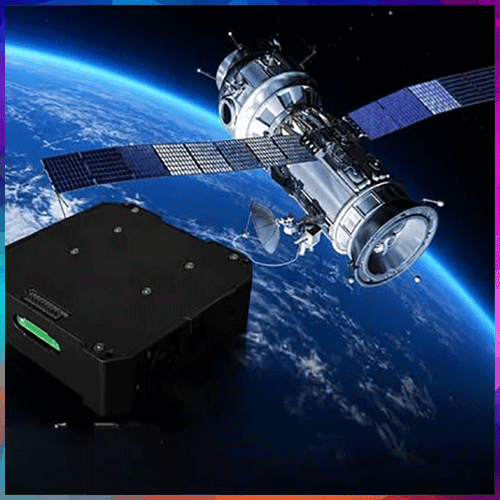
Designed for CubeSats and microsatellites, PowerBank-50 is a lightweight lithium-ion battery pack weighing about 380 grams and capable of storing more than 50 watt-hours of energy. The system integrates an intelligent battery management platform, onboard thermal control and a rugged aluminium enclosure to support satellite operations in low Earth orbit for missions lasting up to five years.
For satellite manufacturers, achieving flight heritage significantly enhances a product's commercial credibility. Space missions involve high financial investments, and hardware failures can jeopardise entire launches. As a result, launch providers, satellite developers and insurers typically favour components that have already demonstrated reliable in-orbit performance.
Battery systems are among the most critical spacecraft components because they must continue supplying power whenever satellites move into Earth's shadow and solar panels temporarily stop generating electricity. They are also required to withstand repeated cycles of heating and cooling while maintaining consistent performance throughout the mission.
Boost for India's expanding space economy
The successful demonstration of an indigenous, flight-qualified satellite battery is expected to strengthen India's growing private space industry. Until now, many Indian satellite developers relied on imported battery systems, often facing higher costs and longer procurement cycles.
A commercially available domestic alternative can help reduce development timelines, improve supply chain resilience and lower costs for startups, research institutions and academic organisations building small satellites. Easier access to proven space-grade components is also expected to encourage greater innovation across India's emerging space technology ecosystem.
Beyond the space industry, reliable satellite technologies play a vital role in services that support everyday life, including weather forecasting, navigation, disaster management, precision agriculture, broadcasting and communications. As India expands its satellite capabilities, indigenous technologies such as PowerBank-50 are expected to contribute to a more self-reliant space ecosystem while supporting the country's long-term ambitions in commercial space exploration and satellite deployment.

See What’s Next in Tech With the Fast Forward Newsletter








Tweets From @varindiamag
Nothing to see here - yet
When they Tweet, their Tweets will show up here.