
Breaking News
OpenAI has slashed prices for two of its AI models by as much as 80%, escalating price competition in the generative AI market as enterprise customers demand lower costs and Chinese rivals continue to undercut leading U.S. model providers.
The company reduced prices for its lightweight GPT-5.6 Luna model by 80% and lowered pricing for its mid-tier GPT-5.6 Terra model by 20%, while leaving its flagship GPT-5.6 Sol model unchanged.
The move reflects growing pressure on AI providers to make large language models more affordable as enterprises increasingly scrutinise AI spending and shift from flat subscriptions to usage-based pricing.
OpenAI said businesses using Luna will now pay $0.20 per million input tokens, down from $1, while output token pricing falls from $6 to $1.20. Terra input pricing falls to $2 per million tokens from $2.50, while output pricing declines from $15 to $12.
The company reduced prices for its lightweight GPT-5.6 Luna model by 80% and lowered pricing for its mid-tier GPT-5.6 Terra model by 20%, while leaving its flagship GPT-5.6 Sol model unchanged.
The move reflects growing pressure on AI providers to make large language models more affordable as enterprises increasingly scrutinise AI spending and shift from flat subscriptions to usage-based pricing.
OpenAI said businesses using Luna will now pay $0.20 per million input tokens, down from $1, while output token pricing falls from $6 to $1.20. Terra input pricing falls to $2 per million tokens from $2.50, while output pricing declines from $15 to $12.
The new pricing places Terra below Anthropic's mid-tier Claude Sonnet 4.6, which costs $3 per million input tokens and $15 per million output tokens, intensifying competition in the enterprise AI market.
The reductions also come as U.S. AI developers face increasing competition from lower-cost Chinese open-source models such as Z.ai's GLM-5.2, which analysts say are approaching the performance of leading proprietary systems at substantially lower prices.
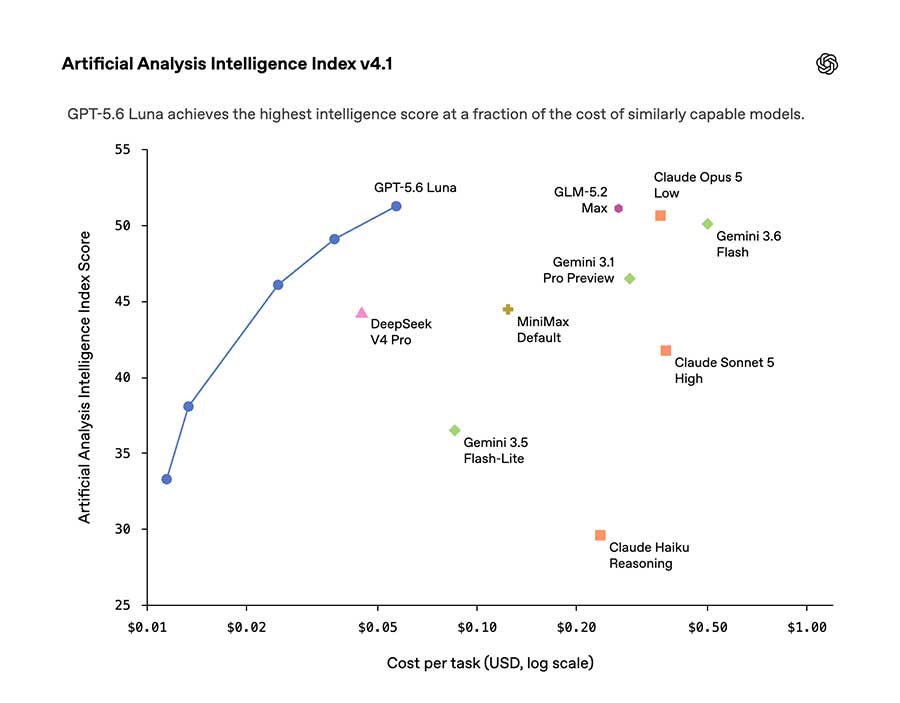
OpenAI said the lower prices were enabled partly by efficiency improvements in GPT-5.6, including internal optimisations that reduced inference costs while maintaining model capabilities. The company argued that smaller models can now perform tasks that previously required more expensive frontier models, allowing enterprises to reduce AI operating costs without sacrificing performance.
The announcement highlights a broader shift in the economics of enterprise AI. While the cost per token has steadily declined over the past year, organisations are increasingly paying for AI based on usage rather than subscriptions, making total AI spending less predictable as workloads expand.
Industry executives have repeatedly argued that lower inference costs are essential for wider enterprise adoption of AI. Analysts also say aggressive pricing could increase model usage but may pressure margins for leading AI providers, many of which continue to invest heavily in computing infrastructure while moving toward potential public listings.
The latest price cuts suggest competition among foundation model providers is increasingly shifting beyond benchmark performance to cost efficiency. As enterprises place greater emphasis on return on AI investment, pricing, inference efficiency and total cost of ownership are emerging as key differentiators alongside model capability.

See What’s Next in Tech With the Fast Forward Newsletter






START - UP



Tweets From @varindiamag
Nothing to see here - yet
When they Tweet, their Tweets will show up here.