

Salesforce study finds unified customer data key to unlocking AI-driven marketing in India

Salesforce's latest State of Marketing report reveals widespread AI adoption among Indian marketers, but fragmented customer data continues to limit personalization, customer engagement, and the effective use of AI agents despite growing enterprise investments.
Salesforce has released the India findings of the tenth edition of its State of Marketing report, revealing that while artificial intelligence (AI) adoption has become mainstream among marketers, fragmented customer data remains the biggest obstacle to delivering personalized customer experiences.
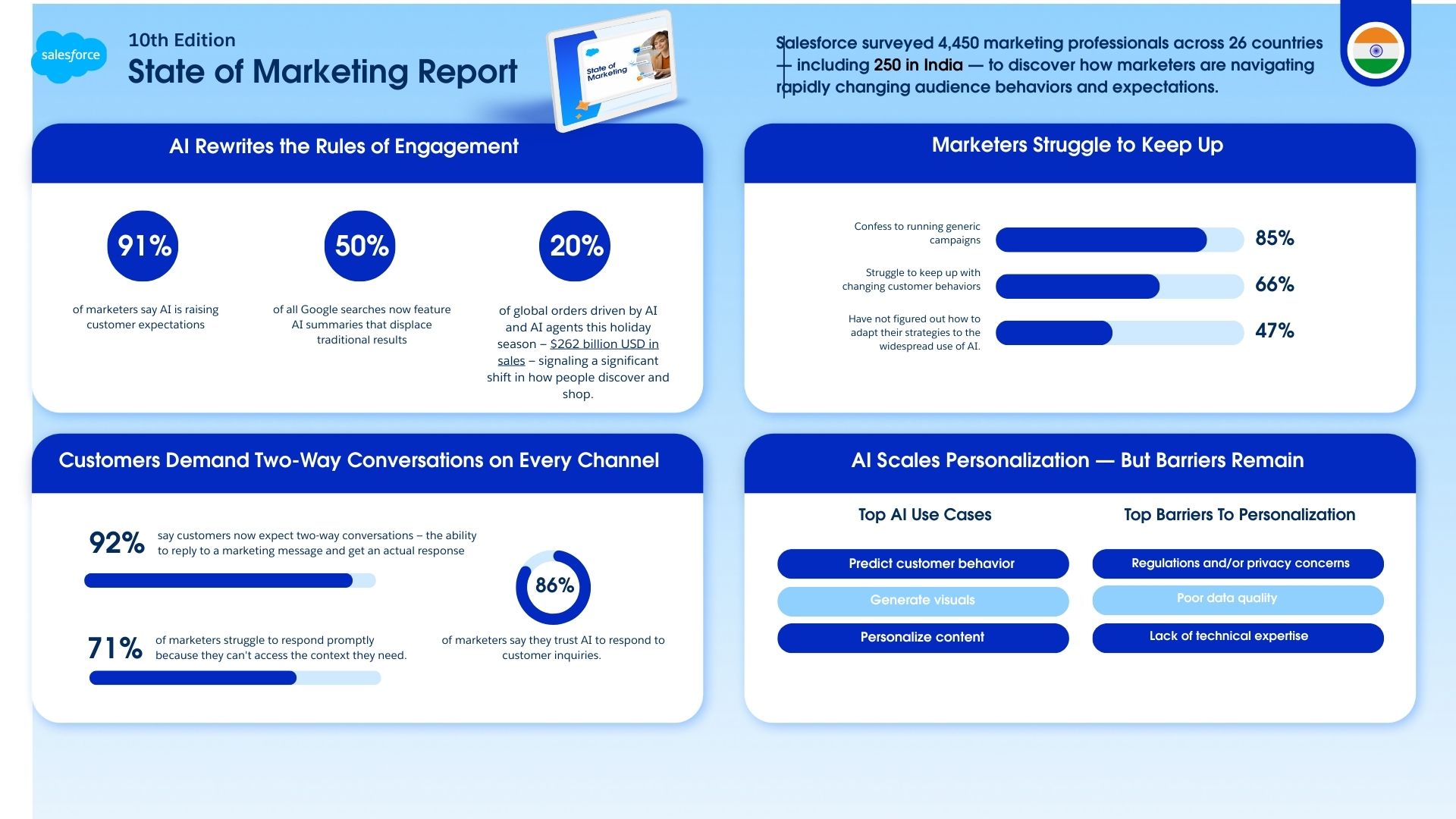
According to the report, 81% of marketers in India have adopted AI, reflecting growing confidence in the technology. However, disconnected systems and poor-quality customer data continue to prevent organizations from fully leveraging AI-powered personalization and customer engagement.
The study found that although 86% of marketers trust AI to respond to customers and help scale engagement, many are unable to capitalize on its potential because relevant customer information remains scattered across multiple systems.
"The biggest barrier to personalization today isn't AI, it's the quality and connectedness of the data that powers it. As AI agents become the next frontier of marketing, organizations need a trusted, unified view of the customer to deliver contextual, real-time engagement at scale. The future of marketing lies in moving beyond one-way campaigns to intelligent, two-way conversations that build stronger, lasting customer relationships," said Nishant Kalra, Vice President - Sales, Salesforce South Asia.
Unified data gives early movers a competitive edge
The research highlights that organizations with unified customer data are already outperforming those relying on fragmented data sources.
Marketing teams satisfied with their data integration are 1.4 times more likely to respond to customers regularly than those with disconnected customer information. They are also 1.6 times more likely to deploy AI agents to scale customer engagement and marketing operations.
Salesforce said unified customer data is becoming a critical requirement as enterprises transition from traditional campaigns to AI-powered, real-time customer interactions.
Personalization efforts hindered by data silos
The report indicates that customer expectations are shifting rapidly toward interactive engagement, with 92% of marketers saying customers now expect two-way conversations rather than one-way promotional messaging.
However, 71% of marketers admitted they struggle to respond quickly because they lack access to the contextual customer information needed to deliver meaningful interactions.
Data accessibility also remains limited across business functions. Only 60% of marketers reported complete access to customer service data, while 61% have access to sales data and 58% can access commerce-related information, highlighting persistent organizational silos.
Meanwhile, the demand for personalized content continues to rise. Around 83% of marketers said they need more personalized content than they are currently able to produce, prompting 81% to adopt AI to bridge the gap.
Despite growing AI adoption, nearly all respondents (98%) reported facing barriers to personalization. Regulatory and privacy concerns, poor data quality and a shortage of technical expertise emerged as the most significant challenges.
High performers lead in AI and data integration
The study found that organizations already using AI agents report stronger integration across customer touchpoints.
Among marketers using AI, 76% expressed satisfaction with their ability to connect customer interactions across channels, compared with 55% of those not using AI.
High-performing marketing organizations are also 1.7 times more likely to leverage customer data for creating relevant experiences and equally more likely to have unified their customer data across systems.
AI Is reshaping customer discovery
The report suggests marketers are navigating significant changes in customer behaviour driven by AI-powered search and discovery tools.
Nearly two-thirds (66%) of marketers said they are struggling to keep pace with evolving customer behaviour, while 47% acknowledged they have yet to adapt their marketing strategies to widespread AI adoption.
According to the findings, AI-generated search summaries and large language models are increasingly influencing purchase decisions, reducing direct visits to brand websites and changing the traditional customer acquisition funnel.
As a result, 91% of marketers observed that AI is raising customer expectations, while 92% said customers increasingly expect conversational interactions across every communication channel.
Answer engine optimization gains momentum
The report also points to the growing importance of Answer Engine Optimization (AEO), as AI-powered search experiences become more prevalent.
According to Salesforce, 91% of marketers believe AI is reshaping their search engine optimization strategies, while 92% have already begun optimizing content for AI-generated responses on platforms such as ChatGPT and Google's AI Overview.
The study found that although AI-generated answers make it more challenging for brands to capture customer attention, the resulting engagements tend to be more personalized and indicate stronger purchase intent.
High-performing marketers were found to be 2.2 times more likely than underperforming organizations to have already optimized their marketing strategies for AI-driven search experiences.

See What’s Next in Tech With the Fast Forward Newsletter


Tweets From @varindiamag
Nothing to see here - yet
When they Tweet, their Tweets will show up here.