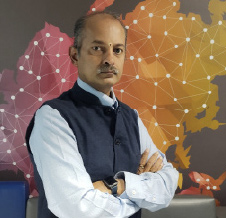

TOWARDS A DIGITALLY INCLUSIVE SOCIETY

DR. ASOKE K. LAHA
Chairman-Emeritus and Founder,
InterraIT
The digital infrastructure is a major benchmark to measure the level of development of a country. Foremost is the assumption that people who use digital highways will be more educated. Secondly, they will have more employability and can command knowledge to access things that people who do not have such knowledge. Third, people who have digital knowledge, will be more worldly-wise since they can operate digital tools like internet, smartphones, personal computers and a host of other items. Fourth, a digitally strong country will have a strong environment for R&D, innovation and disruption.
These days countries which have an upper hand in digital space are known for their digital competitiveness, which is a hallmark for their upward movement and inclusivity. Let us have a look at those countries which are high in the pecking order.
The recent 2025 IMD World Digital Competitiveness Ranking has highlighted the list of 10 countries that stand out on the digital ranking in terms of outstanding infrastructure, talent pool, innovation ecosystems and readiness to accept emerging technologies, including Artificial Intelligence. Switzerland tops the list with 100 marks and satisfies all criteria laid out for measuring competitiveness.
The US follows closely with a mark of 99.29%, a shade lower than Switzerland. Singapore comes third, followed by Hong Kong, Denmark, Netherlands, Canada, Sweden UAE, and Taiwan, occupying the tenth position.
This conveys many things. First, two most populous countries in the world, Mainland China and India are not there in the pecking order of 10. I am sure their rankings will be high in the remaining group of below 10. That takes me to the point of inclusivity. When these countries, most populated ones, are not there, digital inclusivity takes a knocking. But the saving grace is that these two countries are taking several steps to permeate digital culture across the grassroots and such endeavors are started showing results. This can lead to shoring up of index of digital inclusivity.
It is also instructive to look at the countries that are in the bottom line to assess their development tempo. Among them include Mexico, Burkina Faso, Guatemala, Georgia, and the long list ends at Myanmar, which occupies the last position in the pecking order.
How this ranking has been made? Among other things, one criterion was ratio of R&D spending on GDP. For instance, Mexico is ranked among the 25 least technologically advanced countries in the world. In 2022, the country spent only 0.27% of its GDP on research and development. Although Mexico has a growing IT sector with potential for advancement in the tech sector, it still faces many challenges including low R&D investment, skills gap, lack of focus toward innovation, inadequate policies, and poor infrastructure.
Burkina Faso is another illustrative example. This Country is ranked 24th on the list. Its economy is dependent on traditional sectors such as agriculture and mining which limits the focus on other high-growth tech sectors. Moreover, lack of investments and low income contribute to the absence of tech developments in the country.
Georgia spent 0.24% on research and development in 2022. The developing country relies on non-tech sectors for its economy. It is one of the least technologically advanced countries in the world.
Myanmar occupies the bottom slot since its spending on R&D is only 0.04 of the GDP. The biggest challenges faced by the country include the rule of law, the role of the military, corruption, property rights, and social intolerance. Also, we must bear in mind, the countries that have found places in ranking have lesser number of population and therefore, they can have an advantage in ruling high in the digital inclusivity index.
There is another way of looking at things. That is measuring digital inclusivity from the continental perspectives. Continents that are lagging are Africa, Asia and Latin American region, where digital penetration is relatively tardy and slow. There are valid reasons for that. First is the size of demography. India and China are relatively ahead of other countries regarding digital penetration. But lags in digital inclusivity or competitiveness mainly because of the large size of population. But demography is not the only reason for digital backwardness. Smaller countries in Africa like Gabon, where population is very small lag due to lack of investment in the digital sphere. It is due to lack of resources and policy headwinds. There are many such examples, which require a close examination.
Digitization is also related to necessity. Countries which have smaller populations and at the same time command resources to fund development imperatives focus on digitization since they have shortage of manpower. That is the reason for countries to strengthen their digital backbone to replace manpower wherever possible.
Incidentally, breakthroughs in the digital sphere are also connected with innovation index. Countries that have a strong pathway to promote innovation and disruption develop faster digitally. All planks in digitization, such as widespread application AI, robotics, block chain etc. may be scaling up the technology value chain but has a wider objective to meet the shortage of people. Digital competitiveness of countries that face this need will be high as is evident in some Scandinavian countries, which are facing demographic decline.
What is the way forward? I feel, to leap forward the technological gaps in countries, where it is conspicuous, sharing of technology is the only feasible solution since building an indigenous ecosystem would take long years. It is in the interest of technology savvy countries to share the technology, which should be adapted to the needs of the host country. It is not sharing the technology alone. There should be definitive steps towards laying the digital infrastructure in countries bypassed by the digital revolution.
Happily, there are some pioneering efforts happening. Foremost is the undersea cable digital infrastructure laying to connect Africa with rest of the world. Africa is experiencing a major boom in undersea cable projects, led by massive consortiums like 2Africa (Meta) and Google's Equiano, alongside others like Africa-1, Peace, and Medusa, aiming to boost digital connectivity, speed, and affordability with new high-capacity routes circling and connecting the continent to Asia and Europe, supporting digital economies and innovation.
These projects will provide cheaper internet to meet soaring demand for cloud, video, and mobile services, driving economic growth and digital inclusion. Digital projects in Latin America focus on boosting inclusive growth, digital skills, and infrastructure via initiatives in AI, cybersecurity, fintech, e-government, and connectivity, with key efforts from the UNDP Digital 4 Development Hub, EU Digital Alliance, and regional bodies like CEPAL, leveraging public-private partnerships for services from earth observation (Copernicus) to data- driven public services, with Brazil leading in AI investment and hubs like Mexico City emerging as tech centers.
It is not alone trade and investment that are needed to build bridges between countries. Digital cooperation is also an important plank to connect the world and to build a just and fair society.

See What’s Next in Tech With the Fast Forward Newsletter









Tweets From @varindiamag
Nothing to see here - yet
When they Tweet, their Tweets will show up here.