
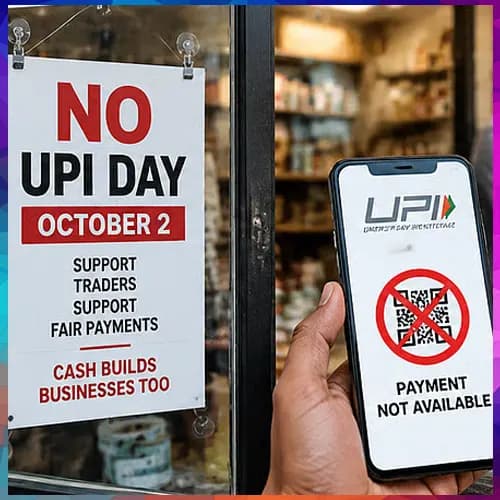
Business associations plan to cover UPI QR codes and payment devices in black cloth on Gandhi Jayanti, protesting the government's decision to impose a 0.4% merchant fee on UPI transactions above ₹2,000 starting October 15.
Trade and business associations across India have called for a nationwide protest, dubbed "No UPI Day," on October 2, opposing the introduction of a merchant discount rate (MDR) of 0.4 per cent on Unified Payments Interface (UPI) transactions exceeding ₹2,000, set to take effect from October 15.
As part of the demonstration, traders plan to symbolically cover UPI scanners, QR codes, sound boxes and related payment devices with black cloth — a protest method associated with Mahatma Gandhi, whose birth anniversary falls on the same date.
Trade bodies unite in opposition
The Maharashtra Chamber of Commerce, Industry & Agriculture (MACCIA) has spearheaded the call for the protest. Its president, Ravindra Mangave, said the organisation has coordinated with trader associations nationwide to ensure the protest extends beyond Maharashtra. He added that MACCIA, along with its roughly 500 affiliate bodies, intends to meet the state's chief minister to formally present their concerns.
Mangave named several major organisations backing the protest, including the Federation of Retail Traders Welfare Association, the All India Consumer Products Distributors Federation (AICPDF), the All India Mobile Retailers Association, the All India Jewellers and Goldsmith Federation, and the All India Edible Oil Traders Federation.
Under the current framework, peer-to-peer UPI transfers remain fee-free, while payments to small merchants receiving up to ₹1 lakh monthly are also exempt from the MDR. The new fee applies specifically to merchant transactions above ₹2,000, capped at ₹300. Data shows UPI processed 15.51 billion merchant transactions worth ₹8.95 trillion in August alone, with payments above ₹2,000 accounting for roughly two-thirds of that value.
Industry leaders warn of rising costs
AICPDF national president Dhairyashil Patil argued that retailers and distributors, already operating on narrow margins, should not have to absorb additional costs tied to digital transactions, saying such charges add friction rather than easing it.
Shankar Thakkar, national president of the All India Edible Oil Traders Federation, said opposition to the fee is widespread among traders nationally and warned that further agitation could follow if the government does not reconsider. He noted that UPI's growth has made retail payment chains significantly more transparent, with transactions traceable from customer to retailer, wholesaler and manufacturer. He questioned why the cost of this transparency should fall on small retailers already conducting recorded, digital transactions.
Separately, discussions on similar exemptions have taken place with petroleum dealers, while the Securities and Exchange Board of India has said it will examine concerns raised by stockbrokers over MDR charges applicable to capital market transactions, which have been fixed at 0.02 per cent with a ₹300 cap.