
The global NAND market in the second quarter of 2026 was defined by the migration of AI workloads from training to inference, according to Counterpoint Research's Q2 2026 Memory & Storage Tracker, a shift that pushed enterprise SSDs to 48% of total bits shipped and left consumer supply short. The resulting supply tightness drove industry revenue to record levels, rising fivefold from the second quarter of 2025, the firm said.
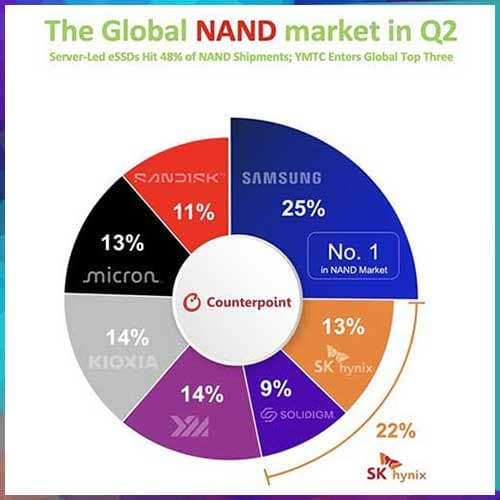
Samsung maintained its lead in NAND shipment share at 25%, followed by SK hynix at 22%, according to Counterpoint Research. YMTC climbed to third place for the first time with a 14% share, narrowly edging out Kioxia, with Micron trailing the top four.
The competitive landscape shifted beneath the shipment rankings, the firm said. Samsung faced capacity constraints, and a preference for higher-margin DRAM production capped its NAND output. SK hynix's performance was buoyed by subsidiary Solidigm, whose bit shipments grew 40% quarter over quarter, according to Counterpoint Research. YMTC grew 22% year over year and 5% quarter over quarter, the firm said, capitalizing on widespread shortages by broadening supply to domestic OEMs while mass-producing 267-layer 3D NAND and advancing 300-plus-layer technology built on its Xtacking architecture.
Kioxia, ranked third in the prior quarter, directs more than 30% of its shipments to servers, according to Counterpoint Research, but rising server prices slowed customer purchases and left its growth trailing YMTC's. Micron rounded out the top five in shipments while still ranking ahead of YMTC in revenue, the firm said.
YMTC ranked third in shipments for the quarter but fifth in revenue, behind Micron and Kioxia, according to Counterpoint Research, because its product mix remains concentrated in consumer applications with a low share of high-priced data center enterprise SSDs. The firm said YMTC plans to shift its mix further toward enterprise SSDs in the second half of the year to cement its third-place shipment position globally, supported by growing avenues for capital support.
Counterpoint Research said AI has become the defining variable for NAND demand as the shift from training to inference drives demand for storage that can hold key-value caches and datasets at high speed and low power. Alongside premiumization toward ultra-high capacity and performance, the firm expects enterprise SSDs in servers to absorb more than half of all NAND bits by the end of the year, a trend that has pushed consumer average selling prices to record highs.
What it means for enterprise buyers
The bit-share shift toward enterprise SSDs has direct procurement implications for IT leaders managing storage budgets tied to AI infrastructure. With servers set to absorb the majority of NAND bits industrywide, Counterpoint Research said supplier profitability through 2027 will be determined less by who ships the most bits and more by who ships the right mix of high-margin enterprise capacity versus commodity consumer product — a dynamic that could affect lead times and pricing stability for enterprises sourcing SSDs at scale.
Buyers should also expect continued pressure on consumer-grade storage pricing as long as manufacturers prioritize enterprise capacity, according to the firm's data, a tradeoff worth factoring into procurement timelines for both data center expansion and standard endpoint hardware refresh cycles.
Samsung maintained its lead in NAND shipment share at 25%, followed by SK hynix at 22%, according to Counterpoint Research. YMTC climbed to third place for the first time with a 14% share, narrowly edging out Kioxia, with Micron trailing the top four.
The competitive landscape shifted beneath the shipment rankings, the firm said. Samsung faced capacity constraints, and a preference for higher-margin DRAM production capped its NAND output. SK hynix's performance was buoyed by subsidiary Solidigm, whose bit shipments grew 40% quarter over quarter, according to Counterpoint Research. YMTC grew 22% year over year and 5% quarter over quarter, the firm said, capitalizing on widespread shortages by broadening supply to domestic OEMs while mass-producing 267-layer 3D NAND and advancing 300-plus-layer technology built on its Xtacking architecture.
Kioxia, ranked third in the prior quarter, directs more than 30% of its shipments to servers, according to Counterpoint Research, but rising server prices slowed customer purchases and left its growth trailing YMTC's. Micron rounded out the top five in shipments while still ranking ahead of YMTC in revenue, the firm said.
YMTC ranked third in shipments for the quarter but fifth in revenue, behind Micron and Kioxia, according to Counterpoint Research, because its product mix remains concentrated in consumer applications with a low share of high-priced data center enterprise SSDs. The firm said YMTC plans to shift its mix further toward enterprise SSDs in the second half of the year to cement its third-place shipment position globally, supported by growing avenues for capital support.
Counterpoint Research said AI has become the defining variable for NAND demand as the shift from training to inference drives demand for storage that can hold key-value caches and datasets at high speed and low power. Alongside premiumization toward ultra-high capacity and performance, the firm expects enterprise SSDs in servers to absorb more than half of all NAND bits by the end of the year, a trend that has pushed consumer average selling prices to record highs.
What it means for enterprise buyers
The bit-share shift toward enterprise SSDs has direct procurement implications for IT leaders managing storage budgets tied to AI infrastructure. With servers set to absorb the majority of NAND bits industrywide, Counterpoint Research said supplier profitability through 2027 will be determined less by who ships the most bits and more by who ships the right mix of high-margin enterprise capacity versus commodity consumer product — a dynamic that could affect lead times and pricing stability for enterprises sourcing SSDs at scale.
Buyers should also expect continued pressure on consumer-grade storage pricing as long as manufacturers prioritize enterprise capacity, according to the firm's data, a tradeoff worth factoring into procurement timelines for both data center expansion and standard endpoint hardware refresh cycles.