
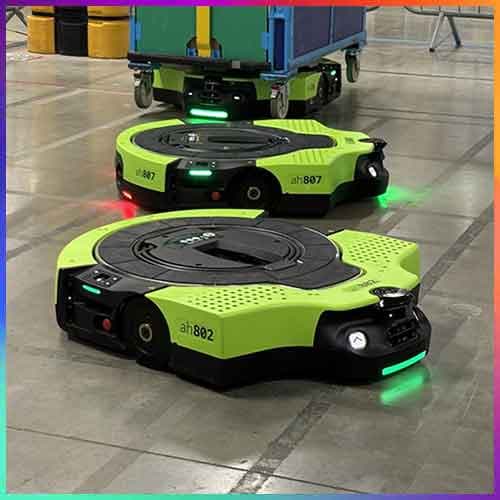
The new version of Proteus can respond to natural language commands and navigate warehouse operations autonomously, highlighting Amazon’s growing investment in AI-driven automation and next-generation fulfilment technologies across Europe.
Amazon has introduced a new version of its warehouse robot Proteus that can understand and act on conversational instructions, marking another step in the company’s efforts to integrate artificial intelligence into logistics and fulfilment operations.
The upgraded robot was showcased during Amazon’s Delivering the Future event in London, where the company outlined its plans to expand automation across its European network. Unlike earlier robotic systems that relied on predefined commands and limited operating zones, the new Proteus is designed to interpret natural language requests from workers and determine how best to complete assigned tasks.
According to Amazon, employees can instruct the robot using everyday language, allowing it to independently plan routes, prioritize activities and transport goods within warehouse facilities.
The latest development forms part of Amazon’s broader strategy to modernize its fulfilment infrastructure. The company has committed €10 billion toward expanding and upgrading its European logistics network over the coming years, with the new Proteus expected to begin deployment in Europe during the first half of 2027.
Expanding automation across warehouses
Proteus was first introduced in 2022 to assist warehouse staff with moving heavy carts and materials. The original version currently operates in dozens of fulfilment centres across the United States.
Alongside the upgraded Proteus, Amazon also highlighted other robotics innovations, including Vulcan, a robot capable of sensing and handling objects more delicately, and STARK, an automated tote-handling system designed to streamline warehouse workflows.
The company believes these technologies can improve efficiency, reduce repetitive tasks and support workers in managing increasingly complex logistics operations.
Automation and employment debate continues
Amazon’s latest robotics push comes amid a wider industry debate about the impact of AI and automation on employment. Over the past two years, several technology companies have reduced headcount while simultaneously increasing investments in AI infrastructure and automation tools.
Amazon executives, however, maintain that robotics is creating demand for new categories of skilled jobs rather than simply replacing workers. Company leaders say roles involving robotics maintenance, automation systems, engineering and technical support are becoming increasingly important as fulfilment centres adopt more advanced technologies.
The company also points to ongoing investments in workforce development, including apprenticeship programmes and training initiatives aimed at helping employees acquire skills needed for automated workplaces.
Industry analysts remain divided on the long-term effects of AI-driven automation. While supporters argue that technology can boost productivity and create new opportunities, others caution that rapid advances in robotics could eventually reshape labour markets and reduce demand for certain types of work.
For Amazon, however, the focus remains on combining human expertise with intelligent machines to improve efficiency across its global logistics network.