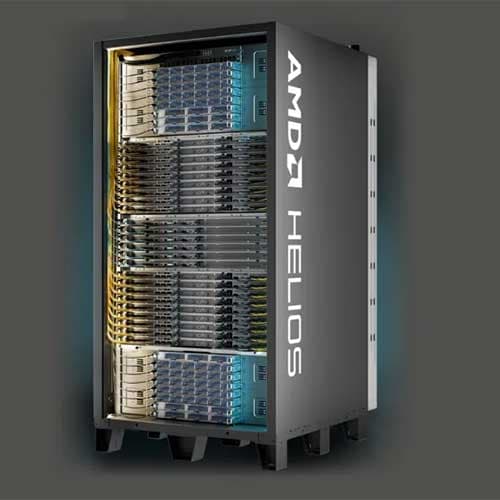
At Advancing AI 2026, AMD launched the Helios rackscale solution, a new rackscale AI infrastructure designed for frontier AI, large-scale inference and foundation-model training. AMD Helios combines AMD Instinct MI455X GPUs, 6th Gen AMD EPYC server CPUs, AMD ROCm software and AMD Pensando networking into a unified rack-scale architecture that delivers exaflop-class AI performance, industry-leading memory capacity and bandwidth, and exceptional scalability.
As demand grows for AI factories and frontier AI, customers need infrastructure that scales efficiently from a single rack to large gigawatt-scale AI clusters while maximizing performance, performance per watt and cost per token. AMD Helios delivers an integrated rack-scale building block that simplifies deployment while providing the compute, networking and open software foundation needed for the next generation of AI infrastructure. AMD Helios rackscale AI solution offers the highest token throughput performance at low, medium and high interactivity levels, designed with an open architecture from the start. Compared to the leading competitive solution, AMD Helios delivers 15% more peak FP4 performance, 50% more high-bandwidth memory (HBM) capacity, 6% more HBM bandwidth and 50% more scale-out bandwidth. It delivers up to 30% more tokens per dollar than the competitive solution, giving customers more output with every rack they deploy.
“Frontier AI infrastructure is evolving rapidly, and customers need platforms that can deliver exceptional performance while scaling efficiently as workloads grow. AMD Helios brings together leadership compute, high-performance networking and open software in a unified rack-scale platform. Together, these technologies give customers the flexibility to accelerate large-scale inference, frontier-model training and the next generation of AI infrastructure,” said Vamsi Boppana, Senior Vice President, AI, AMD.
AMD Helios extends the AMD AI portfolio by delivering an open rack-scale architecture designed to support large-scale inference, frontier-model training and fine-tuning from a single rack to multirack clusters. AMD delivers AMD Helios at the same time AI is reshaping modern compute infrastructure, requiring tightly integrated platforms that combine high-performance compute, rack-scale architectures and open software.
Built for Frontier AI: AMD Helios is the AMD rack-scale AI infrastructure platform designed for frontier AI and AI factory deployments. It provides a scalable foundation for high-volume inference, frontier-model training and fine-tuning by bringing together AMD 5th Gen Instinct GPUs, 6th Gen AMD EPYC server CPUs, AMD Pensando networking and AMD ROCm software into a unified platform built on open standards.
Leadership Rack Performance: AMD Helios delivers exaflop-class AI performance in a unified architecture optimized for large-scale inference and frontier-model development. A single rack provides up to 2.9 exaflops peak FP4, 1.4 exaflops peak FP8, 31 terabytes of HBM4 memory and 1.7 petabytes/second of memory bandwidth.
Scalable AI: AMD Helios is designed to scale from a single rack to gigawatt-scale AI clusters. Each rack integrates 18 open rack wide-aligned 4-GPU compute trays (72 total GPUs) that provide consistent building blocks for cluster deployment and expansion. At cluster scale, AMD Pensando™ Vulcano 800 AI NICs provide the high-bandwidth, low-latency connectivity required to support distributed inference, frontier-model training and rapid hyperscale growth.
Open Infrastructure: AMD Helios combines UALink over Ethernet (UALoE) for high-performance scale-up with standards-based Ethernet aligned with the Ultra Ethernet Consortium for scale-out, enabling customers to build AI infrastructure using open, standards-based technologies. The platform also incorporates defense-in-depth rack-scale security features. AMD ROCm software enables high-throughput inference and unified distributed training across rack and cluster-scale deployments.