
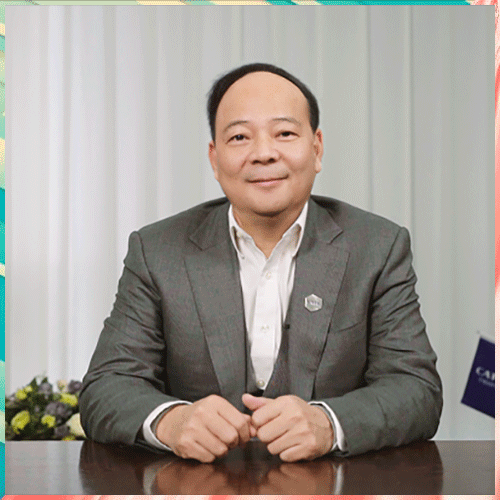
Robin Zeng, founder and chairman of CATL, has quietly built one of the world's most influential technology companies. Rising from humble beginnings in Fujian province, he transformed CATL into the global leader in electric vehicle batteries through engineering excellence, disciplined execution, and a long-term vision. Unlike many high-profile technology leaders, Zeng has remained largely out of the spotlight, allowing innovation and manufacturing scale to define CATL's success.
Zeng recognized early that batteries would become the foundation of the electric mobility revolution. After spinning off CATL from ATL in 2011, he secured strategic partnerships with global automakers, particularly BMW, establishing credibility in international markets. Strong domestic support and rapid EV adoption in China accelerated CATL's expansion into a global industry leader.
Scale has become CATL's greatest competitive advantage. With more than one-third of the global EV battery market, the company continuously reinvests in research and development. Innovations such as the Shenxing fast-charging battery demonstrate CATL's ability to push technological boundaries while strengthening its leadership in battery performance, safety, and manufacturing efficiency.
CATL's influence now extends far beyond battery manufacturing. Automakers increasingly build vehicle platforms, software integration, and supply chains around CATL's battery technologies, making switching suppliers both costly and operationally complex. This ecosystem advantage mirrors how NVIDIA's CUDA platform became indispensable for AI computing.
Despite its technological leadership, CATL faces growing geopolitical challenges. U.S. restrictions and increased scrutiny of Chinese technology companies have complicated global expansion. In response, CATL has pursued international manufacturing investments, a Hong Kong secondary listing, and broader global partnerships to diversify financing and strengthen its international presence.
Zeng's ambition extends beyond electric vehicles. He envisions CATL as a cornerstone of the global zero-carbon economy, investing in energy storage, sustainable manufacturing, advanced battery chemistry, and carbon-neutral operations. His pragmatic assessment of solid-state battery development reflects a leadership style focused on long-term innovation rather than short-term hype.
Robin Zeng's journey closely parallels Jensen Huang's in one important respect: both identified foundational technologies before the market fully appreciated their importance. While NVIDIA powers the AI revolution through computing, CATL powers the energy transition through advanced batteries. The next phase of CATL's growth will depend not only on technological leadership but also on its ability to navigate an increasingly complex geopolitical environment while maintaining its innovation advantage.