
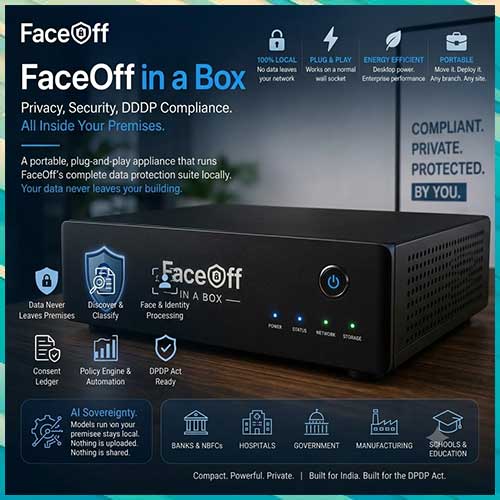
FaceOff has launched FaceOff in a Box, a compact, portable hardware appliance that runs the company's complete security and privacy suite entirely inside an organization's own premises. Aimed at Indian companies racing to meet Digital Personal Data Protection Act obligations before the compliance deadline, the product is built around one core promise: the data never leaves your building.
The appliance is small enough for a desk or cupboard, light enough to carry between branch offices, and deployable in factories, hospitals, bank branches, schools, or district offices — with none of the civil work, rack space, or cooling a traditional server room demands. Discovery, classification, protection, masking, monitoring, auditing, and compliance reporting all run inside the box itself.
This matters because under DPDP, accountability for personal data stays with the collecting organization even after handing data to a processor or cloud platform — consent records, retention schedules, erasure requests, and breach reporting obligations don't travel with the data. That's created discomfort among boards uneasy about shipping sensitive records to external platforms simply to prove compliance. FaceOff in a Box removes that contradiction: nothing is uploaded, mirrored externally, or processed on shared infrastructure.
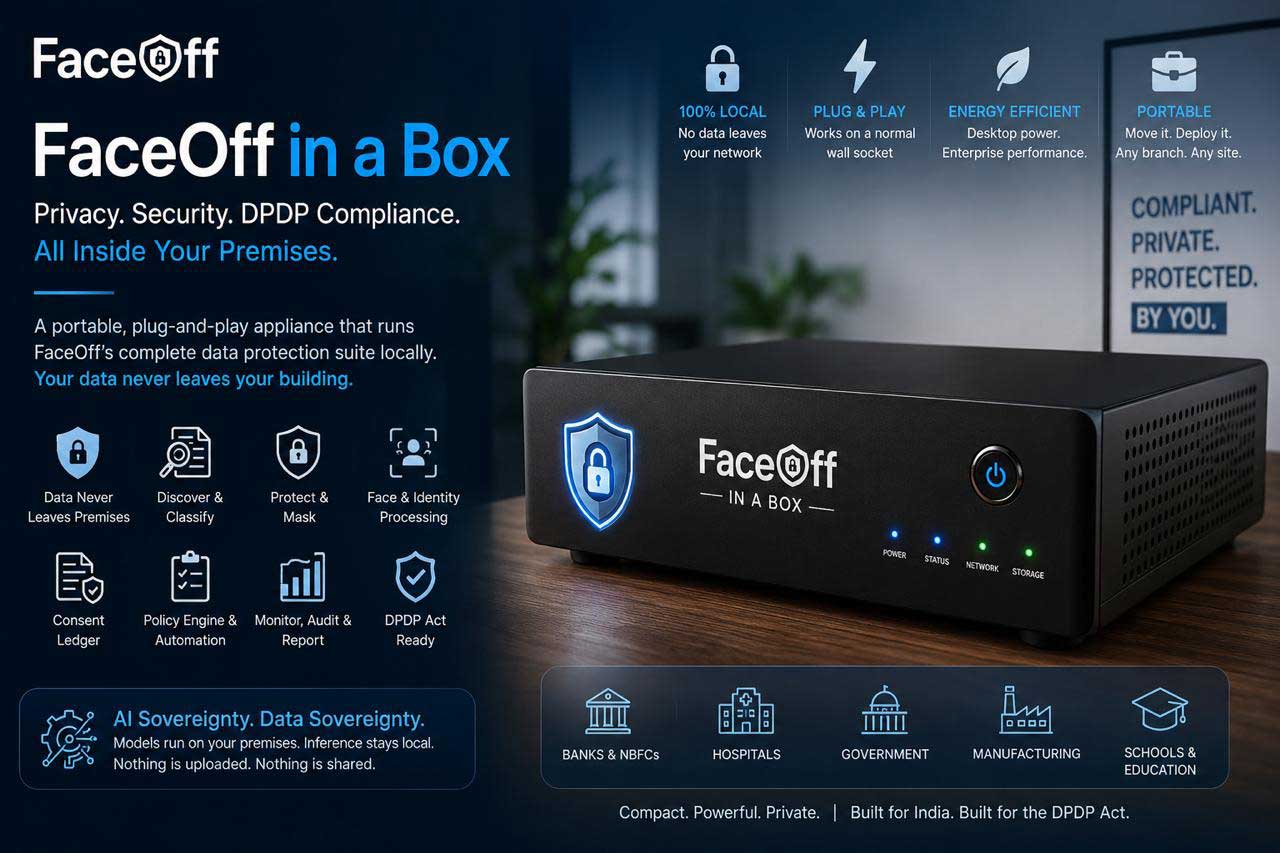
What's notable is the computing power packed into the appliance. Rather than requiring a server rack, it uses desktop-class AI hardware with a large pool of unified memory, letting sizeable language and vision models run entirely locally, at power draw comparable to an ordinary workstation. For lighter deployments, a thumb-sized accelerator can extend the same local processing to existing branch computers.
This delivers something few compliance products offer: AI sovereignty alongside data sovereignty — models, inference, and outputs never reach a third-party provider, a distinction that can determine whether a project gets approved in regulated sectors like defense, healthcare, or government.
FaceOff positions this against two failed alternatives: cloud SaaS platforms (which create new data-transfer risk and unpredictable, rising per-record costs) and typical on-premise software (which leaves customers to source and integrate their own heterogeneous hardware). The appliance instead offers one standardized, pre-hardened unit deployable in hours, with predictable one-time cost and no per-record billing.
Key Highlights
● Data never leaves the premises — all discovery, classification, and compliance processing runs locally
● AI sovereignty, not just data sovereignty — models and inference stay entirely on-site, critical for regulated sectors
● Deployment in hours, not months — identical hardware at every site eliminates integration guesswork
● Predictable economics — one-time purchase, no per-record billing, no egress charges
● Dual purpose — built for DPDP compliance, but continues running security functions like identity access control and anomaly detection afterward

See What’s Next in Tech With the Fast Forward Newsletter









Tweets From @varindiamag
Nothing to see here - yet
When they Tweet, their Tweets will show up here.